Ever read a sentence and stumble upon a word that sounds important—but you’re not quite sure what it means? That’s exactly how many people feel when they encounter vitiated meaning in books, legal documents, or academic writing.
It’s not a word you hear in everyday conversation, yet it pops up in places where precision matters—like contracts, arguments, or formal essays. And if you misunderstand it, you could miss the entire point.
So what does it actually mean? Why do people use it instead of simpler words like “ruin” or “weaken”?
In this guide (Updated for 2025), you’ll learn the exact definition of vitiate, where it comes from, how to use it naturally, and how to avoid common mistakes. Plus, you’ll see real-life examples that make it stick.
What Does “Vitiate” Mean? (Definition + Origin)
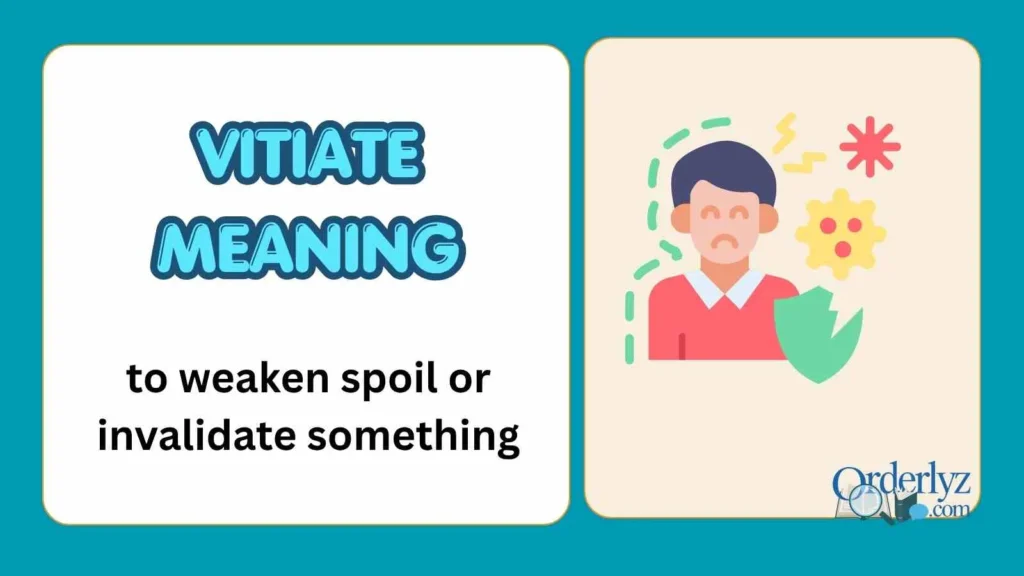
‘Vitiate’ means to spoil, weaken, or make something ineffective or invalid.
It’s often used when something isn’t completely destroyed but is damaged enough to lose its value or credibility.
Quick Answer:
‘Vitiate’ means to weaken, spoil, or invalidate something, especially in formal or legal contexts.
Origin of the Word
The word comes from the Latin “vitiare”, meaning “to spoil or corrupt”. Over time, it entered English through formal writing, which is why it still feels slightly “advanced” or academic today.
How Its Meaning Has Evolved
Originally tied to moral corruption, “vitiate” now applies broadly:
- Legal agreements
- Logical arguments
- Scientific results
- General quality or effectiveness
Pronunciation Guide
‘Vitiate’ is pronounced:
vih-shee-ate or vih-shee-ayt
How to Use “Vitiate” Correctly in Texts & Chat
Let’s be honest—you’re probably not dropping “vitiate” into casual WhatsApp chats. It’s more of a formal vocabulary word.
Tone & Context
Use “vitiate”. when:
- You want to sound precise or professional
- You’re discussing errors, flaws, or invalid results
- Writing essays, reports, or legal arguments
Avoid it when:
- Chatting casually with friends
- Writing informal social media posts
- Speaking to someone unfamiliar with advanced vocabulary
Platform-Specific Usage
- SMS / WhatsApp: Rarely used
- Instagram / TikTok: Almost never
- Twitter/X: Occasionally in intellectual discussions
- Discord / Reddit: Seen in debates or academic threads
Formatting Tips
- Usually written in lowercase: vitiate
- No slang shortcuts
- Often used in formal sentence structures
Example:
“The lack of evidence may vitiate the entire claim.”
Real Conversation Examples Using “Vitiate”
1. Between Students
A: “I worked so hard on this assignment.”
B: “Yeah, but that one major error might vitiate your whole argument.”
👉 Meaning: The mistake weakens the entire work.
2. In a Workplace Discussion
Manager: “If the data is inaccurate, it could vitiate our findings.”
👉 Meaning: Incorrect data could make results unreliable.
3. Legal Context
Lawyer: “Any evidence obtained illegally may vitiate the case.”
👉 Meaning: It could invalidate the case.
4. Between Friends (Semi-Formal)
Friend 1: “This deal sounds perfect.”
Friend 2: “Hidden charges could vitiate the whole thing.”
👉 Meaning: Extra costs could ruin the value.
5. Gaming/Online Debate
Player: “Your strategy was solid, but that mistake vitiated your win.”
👉 Meaning: The error cost the victory.
Common Mistakes & Misunderstandings
1. Thinking It Means “Destroy Completely”
Not quite. “Vitiate” means weaken or spoil, not necessarily total destruction.
❌ Wrong: “The storm vitiated the house.”
✅ Better: “The storm damaged the house.”
2. Using It in Casual Conversations
It can sound unnatural or overly formal.
❌ “That pizza vitiated my mood lol.”
✅ “That pizza ruined my mood.”
3. Confusing It with “Violate”
They sound similar, but meanings differ:
- Vitiate = weaken or spoil
- Violate = break a rule or law
Generational Differences
- Gen Z: Rarely uses it
- Millennials: Recognize but don’t use often
- Professionals/Academics: Use regularly
“Vitiate” Across Different Platforms & Demographics
Usage by Age Group
- Students & academics: Common in essays
- Legal professionals: Frequently used
- General public: Rare
Platform Trends
- Seen more on:
- Academic blogs
- Legal discussions
- Debate forums
- Rare on:
- TikTok
- Snapchat
- Casual Instagram captions
Formal vs Informal
- Formal: Yes ✅
- Informal: No ❌
- Safe for work: Yes
Related Slang, Abbreviations & Alternatives
Here are simpler or related words you can use instead:
| Word | Meaning |
|---|---|
| Weaken | Make less strong |
| Undermine | Gradually damage |
| Impair | Reduce effectiveness |
| Spoil | Ruin quality |
| Corrupt | Damage morally or structurally |
| Invalidate | Make something invalid. |
| Compromise | Reduce strength or quality |
| Damage | Cause harm |
| Ruin | Completely destroy |
| Sabotage | Intentionally damage |
💡 Tip: Use these in casual conversations instead of “vitiate”.
FAQs:
What does ‘vitiate’ mean in simple words?
It means to weaken, spoil, or reduce the effectiveness of something. It doesn’t always destroy something completely, but it makes it less valuable or reliable.
Can vitiate be used in everyday conversation?
Technically yes, but it’s uncommon. Most people prefer simpler words like “ruin” or “damage” in daily speech.
What is an example of vitiate in a sentence?
“The lack of proper evidence vitiated the entire argument.”
This means the argument became weak or invalid.
Is ‘vitiate’ a legal term?
Yes, it’s commonly used in legal contexts to describe something that invalidates or weakens a contract, agreement, or case.
What’s the difference between ‘vitiate’ and ‘invalidate’?
“Vitiate” means weaken or impair, while “invalidate” means completely make something invalid. ‘Vitiate’ doesn’t always imply total failure.
Conclusion:
The ‘vitiate’ meaning might seem complex at first, but it’s actually straightforward once you break it down. It simply refers to weakening, spoiling, or reducing the effectiveness of something.
It’s a powerful word—especially in formal writing, legal discussions, and academic contexts. But outside those areas, simpler alternatives often work better.
If you want to sound more precise and articulate, adding “vitiate” to your vocabulary is a smart move. Just use it in the right context.
Got a favourite word like this? Drop it in the comments and let’s decode it next.

Hi, I’m Sophia Brownn, the creator behind Orderlyz.com, where words, meanings, and expressions are made simple, clear, and easy to understand.
I believe language shouldn’t feel confusing or overwhelming. In a world where new slang, trends, and expressions appear every day, my goal is to bring order to the chaos. I break down meanings in a way that feels natural, quick, and actually useful in real life conversations.