Ever received a result or answer that left you more confused than before? Maybe a test didn’t give a clear answer, or a conversation ended without a solid conclusion. That’s exactly where the term ‘inconclusive’ meaning comes into play.
In today’s fast-moving digital world—where clarity is everything—understanding terms like “inconclusive” helps you communicate smarter and avoid misunderstandings. Whether you’re reading medical reports, analysing data, or just chatting online, this word pops up more often than you think.
In this guide (updated for 2025), you’ll learn what ‘inconclusive’ really means, how to use it correctly, real-life examples, and common mistakes people make. By the end, you’ll confidently use this term in both casual and formal situations.
What Does “Inconclusive” Mean? (Definition + Origin)
Inconclusive means something that does not provide a clear, definite, or final result.
It describes situations where evidence, data, or outcomes are unclear or insufficient to make a firm decision.
Quick Answer:
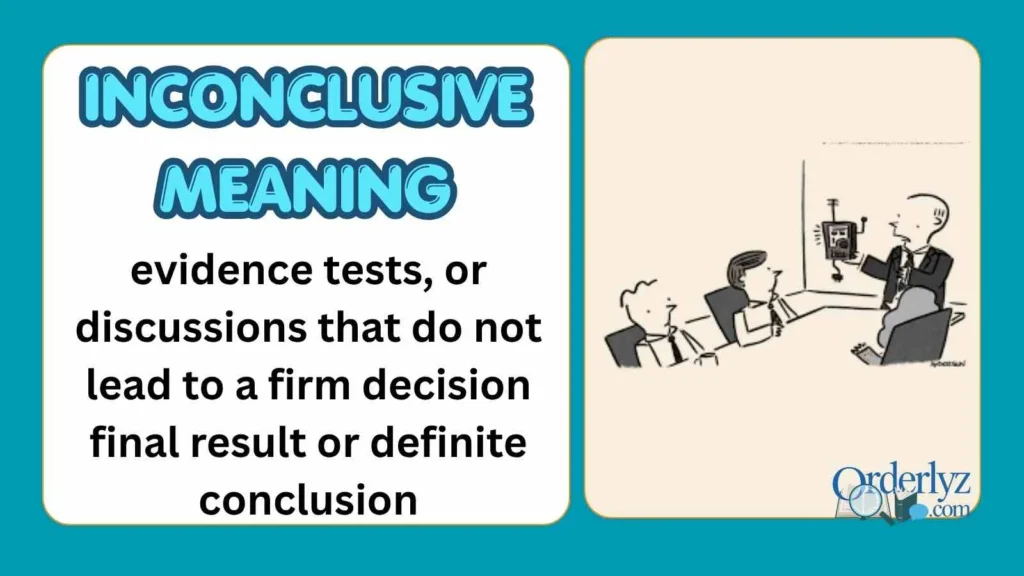
Inconclusive meaning = evidence, tests, or discussions that do not lead to a firm decision, final result, or definite conclusion
Origin & Evolution
The word comes from Latin roots:
- in- (not)
- conclusive (ending or concluding)
Originally used in formal and academic contexts, “inconclusive” is now widely used in everyday conversations—especially in health, research, and decision-making discussions.
Pronunciation
in-kuhn-KLOO-siv
How to Use “Inconclusive” Correctly in Texts & Chat
Tone & Context
“Inconclusive” is typically
- Neutral
- Slightly formal
- Analytical
It’s used when:
- Results are unclear
- Evidence is conflicting
- A final answer isn’t available
Platform Usage
- SMS / WhatsApp:
“The results were inconclusive, so I need another test.” - Instagram / TikTok comments:
Less common, but used in serious discussions
“That video evidence feels inconclusive tbh.” - Discord / Reddit:
Frequently used in debates
“The data is inconclusive—we need more proof.” - Work emails / professional chat:
Very common
“The findings are inconclusive at this stage.”
When NOT to Use It
Avoid using “inconclusive” when
- A clear answer already exists
- You’re in very casual slang-heavy chats (it may sound too formal)
Formatting Tips
- No need for caps (unless emphasizing)
- Can pair with neutral emojis like 🤔
- Often followed by explanation
Real Conversation Examples Using “Inconclusive”
1. Between Friends
A: Did your exam results come out?
B: Yeah, but they’re inconclusive. I might need a recheck.
👉 Shows uncertainty and lack of final outcome
2. Dating Scenario
A: So… do they like you?
B: Honestly, their signals are inconclusive. 😅
👉 Expresses mixed signals or confusion
3. Family Conversation
Mom: What did the doctor say?
You: The test results were inconclusive—they need more tests.
👉 Serious and common real-life use
4. Work Chat
Manager: What’s the final report?
Employee: The data is inconclusive, so we can’t finalise it yet.
👉 Professional and analytical tone
5. Gaming / Online Debate
Player 1: That strategy works 100%
Player 2: Nah, the results are inconclusive at best
👉 Used to challenge claims
Common Mistakes & Misunderstandings
1. Confusing It With “Incorrect”
Wrong: “The answer is inconclusive” (when it’s clearly wrong)
Correct: Use “incorrect” if there’s a definite error
2. Assuming It Means Negative
“Inconclusive” doesn’t mean bad—it just means unclear.
Sometimes it simply means more information is needed.
3. Overusing in Casual Chats
It can sound overly formal in everyday texting.
Instead of “That’s inconclusive lol”
People may say: “Not sure” or “unclear”
Generational Differences
- Gen Z: Rarely uses it in casual slang
- Millennials: Use it in semi-formal contexts
- Professionals: Use it frequently in reports
“Inconclusive” Across Different Platforms & Demographics
Gen Z vs Millennials
- Gen Z prefers simpler phrases like the following:
- “unclear”
- “idk”
- Millennials and professionals stick with “inconclusive”
Platform Trends
- TikTok: Rare, unless educational content
- Instagram: Used in serious captions/comments
- Reddit: Very common in debates
- Discord: Used in gaming and logic discussions
Formal vs Informal
- Formal: ✅ Yes
- Casual: ⚠️ Sometimes
- Safe for work: ✅ Completely
Related Slang, Abbreviations & Alternatives
| Term | Meaning |
|---|---|
| Unclear | Not easy to understand |
| Undetermined | Not decided yet |
| TBD | To be decided |
| Pending | Waiting for a result |
| Ambiguous | Open to multiple meanings |
| Uncertain | Not sure |
| Indefinite | Not clearly defined |
| Up in the air | Informal uncertainty |
| No conclusion | No final answer |
| In doubt | Lacking certainty |
FAQs:
What does inconclusive mean in medical terms?
In medicine, “inconclusive” means test results do not confirm or rule out a condition. More testing is usually required for a clear diagnosis.
Can inconclusive results change later?
Yes. Inconclusive results often lead to further testing, which can eventually provide a clear and conclusive answer.
Is inconclusive the same as negative?
No. ‘Negative’ means a clear ‘no’, while ‘inconclusive’ means there isn’t enough information to decide.
How do you use inconclusive in a sentence?
Example: “The investigation was inconclusive due to lack of evidence.”
Why are some results inconclusive?
Results can be inconclusive due to limited data, errors in testing, conflicting evidence, or unclear conditions during analysis.
Conclusion:
Understanding inconclusive meaning helps you navigate uncertainty with clarity. Whether it’s a test result, a conversation, or a decision, this word signals one thing—no final answer yet.
It’s not good or bad—it simply means more information is needed. And in a world full of quick assumptions, that’s actually pretty important.
Use it wisely in professional settings, and keep it in your vocabulary for moments when things just aren’t crystal clear.
Curious about more terms like this? Drop your favourite word or abbreviation below and keep exploring the world of modern communication.

Hi, I’m Sophia Brownn, the creator behind Orderlyz.com, where words, meanings, and expressions are made simple, clear, and easy to understand.
I believe language shouldn’t feel confusing or overwhelming. In a world where new slang, trends, and expressions appear every day, my goal is to bring order to the chaos. I break down meanings in a way that feels natural, quick, and actually useful in real life conversations.