Curious about the very meaning (and why it matters in everyday English)? You’re not alone.
This essential, powerful word shows up everywhere—from casual conversations to formal writing—but many people still misunderstand how to use it correctly.
In this ultimate, in-depth guide, you’ll discover the exact definition, real-life examples, and smart tips to use “vary” with confidence.
Whether you’re a student, writer, or language learner, this must-know, game-changing explanation will make everything crystal-clear and effortless.
In this updated 2026 guide, you’ll learn:
- The exact definition of vary
- Where the word came from
- How to use it correctly in sentences
- Real-life conversation examples
- Common mistakes people make
- Related words and alternatives
By the end, you’ll know exactly when and how to use the word ‘vary’ naturally in everyday English.
Table of Contents
- What Does “Vary” Mean?
- How to Use “Vary” Correctly in Sentences
- Real Conversation Examples Using “Vary”
- Common Mistakes & Misunderstandings
- “Vary” Across Different Contexts
- Related Words, Synonyms & Alternatives
- Frequently Asked Questions
- Conclusion
What Does “Vary” Mean? (Definition + Origin)
Simple Definition
‘Vary’ means to change, differ, or become different from something else.
It usually describes differences within a group or changes over time.
For example:
- “Prices vary by region.”
- “Opinions vary on this topic.”
In both cases, the idea is that things are not identical — they differ.
Quick Answer
‘Vary’ means to change or differ in amount, type, or level rather than staying the same.
Origin of the Word
The word ‘vary’ dates back to the 14th century and comes from the Latin word ‘variāre’, meaning to change, diversify, or make different.
Over time, the meaning stayed largely the same. Today it’s used in both formal and everyday English.
Pronunciation Guide
Vary pronunciation:
- American English: /VER-ee/
- British English: /VAIR-ee/
Tip: It rhymes roughly with “very”.
How to Use “Vary” Correctly in Texts & Writing
The word ‘vary’ usually appears when you’re talking about differences, fluctuations, or variety.
Common Sentence Patterns
1️⃣ Vary + by
Example:
- “Costs vary by location.”
2️⃣ Vary + depending on
Example:
- “Results may vary depending on experience.”
3️⃣ Vary + from…to
Example:
- “Temperatures vary from 15°C to 25°C.”
4️⃣ Vary + widely/greatly
Example:
- “Opinions vary widely on this issue.”
When to Use “Vary”
Use it when talking about:
✔ differences between things
✔ changing conditions
✔ ranges of values
✔ personal opinions
Example:
“Prices vary depending on the season.”
When NOT to Use It
Avoid varying when something completely transforms.
Example:
❌ “He varied into a different person.”
✔ “He changed into a different person.”
“Vary” usually implies small differences, not total transformation.
Real Conversation Examples Using “Vary”
Here are realistic examples showing how people naturally use the word vary.
Example 1 – Between Friends
Alex: How much are movie tickets there?
Sam: It varies. Weekdays are cheaper.
Meaning: Prices change depending on the day.
Example 2 – Work Conversation
Manager: Delivery times vary depending on traffic conditions.
Meaning: Delivery duration isn’t fixed.
Example 3 – Travel Planning
Traveller: Are hotel prices expensive there?
Guide: They vary by season.
Meaning: Prices differ depending on time of year.
Example 4 – Academic Discussion
Student: Why are the test scores different?
Teacher: Results vary because students study differently.
Meaning: Performance differs among individuals.
Example 5 – Health Advice
Doctor: Recovery times vary from person to person.
Meaning: Each individual heals differently.
Common Mistakes & Misunderstandings
Even simple words like ‘vary’ can confuse learners.
Here are the most common mistakes.
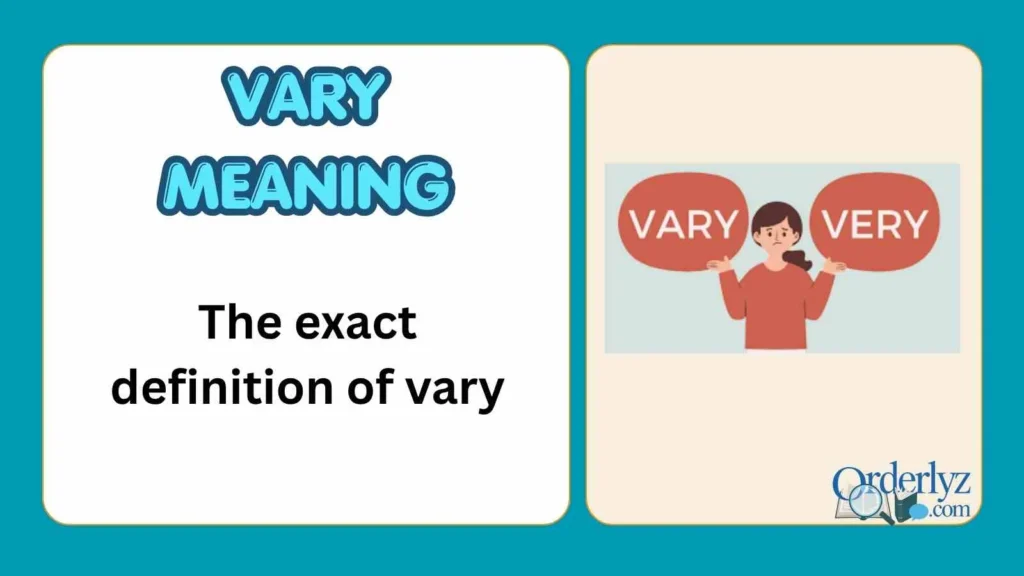
1. Confusing “Vary” With “Very”
These two words sound similar but mean completely different things.
| Word | Meaning |
|---|---|
| vary | change or differ |
| very | extremely |
Example:
✔ “Prices vary by region.”
✔ “The weather is very hot.”
2. Using It When No Difference Exists
Wrong:
“Everyone’s answer varies – they all said the same thing.”
Correct:
“Everyone gave the same answer.”
If something doesn’t differ, it doesn’t vary.
3. Overusing “Vary”
Sometimes simpler words work better:
Instead of:
“His mood varies.”
Say:
“His mood changes.”
“Vary” Across Different Contexts
The word ‘vary’ is used in many areas of communication.
Everyday Conversation
People often use it when talking about:
- prices
- weather
- opinions
- schedules
Example:
“Prices vary depending on demand.”
Academic and Scientific Writing
‘Vary’ often describes relationships between variables in research.
Example:
“Temperature varies with altitude.”
Business and Economics
Common phrases include:
- costs vary
- demand varies
- income varies
Example:
“Incomes can vary widely between industries.”
Online Discussions
You’ll often see phrases like the following:
- “Results may vary”
- “Your experience may vary”
These phrases acknowledge that different people can have different outcomes.
Related Words, Synonyms & Alternatives
Here are common words related to vary.
| Word | Meaning |
|---|---|
| Change | Become different |
| Differ | Be unlike anything. |
| Alter | Modify slightly |
| Fluctuate | Rise and fall repeatedly |
| Shift | Move gradually |
| Modify | Adjust slightly |
| Diversify | Introduce variety |
| Alternate | Occur in turns |
| Adjust | Make small changes |
Synonyms in Casual Language
Instead of “vary”, people sometimes say the following:
- “It depends”
- “It’s different for everyone.”
- “It changes”
Example:
“It depends on where you live.”
FAQs:
What does ‘vary’ mean in simple terms?
It means something changes or differs instead of staying the same. For example, prices or opinions may vary depending on conditions.
What is the past tense of vary?
The past tense is varied.
Example:
“Prices varied last year.”
What is a simple sentence using vary?
Example:
“Travel costs vary by season.”
Is it very formal or informal?
The word works in both formal and casual English, making it very versatile.
What does “results may vary” mean?
It means outcomes can be different for different people depending on circumstances.
Conclusion:
The varied meaning is simple once you understand the core idea: things change or differ instead of staying identical.
You’ll see this word everywhere in conversations, articles, research papers, and everyday explanations.
Remember three key ideas:
- Vary = differ or change
- It often describes ranges or differences
- It’s used in both casual and formal English
Once you start noticing it, you’ll see how often it appears in real life, from weather reports to online reviews.
And yes… your understanding of the word might vary a little depending on context.

Hi, I’m Sophia Brownn, the creator behind Orderlyz.com, where words, meanings, and expressions are made simple, clear, and easy to understand.
I believe language shouldn’t feel confusing or overwhelming. In a world where new slang, trends, and expressions appear every day, my goal is to bring order to the chaos. I break down meanings in a way that feels natural, quick, and actually useful in real life conversations.