Have you ever heard someone say, “A group of hooligans was causing trouble downtown,” and wondered what they actually meant?
The phrase ‘hooligans’ meaning is searched by thousands of people because the word appears everywhere—from news headlines and sports coverage to movies, social media posts, and everyday conversations. Yet many people aren’t completely sure whether it refers to criminals, pranksters, sports fans, or simply noisy troublemakers.
The truth is that “hooligan” has evolved over time. Depending on the situation, it can describe anything from serious public disorder to playful mischief among friends.
In this guide, you’ll learn the exact definition of hooligans, where the term originated, how it’s used today, common misunderstandings, real-life examples, and related slang expressions. This article is updated for 2026 and designed to give you a complete understanding of the word.
What Does “Hooligans” Mean?
Definition
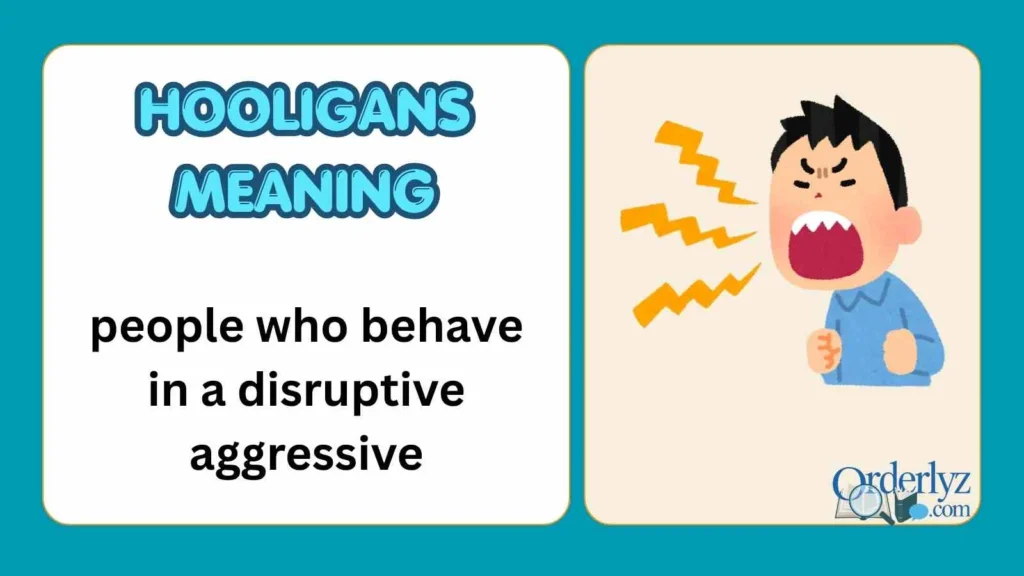
The word ‘hooligans’ refers to people who behave in a disruptive, unruly, aggressive, or troublesome manner, especially in public settings.
A hooligan may:
- Start fights
- Damage property
- Cause disturbances
- Ignore social rules
- Engage in rowdy behavior
Quick Answer
Hooligans are people known for unruly, disruptive, aggressive, or troublesome behaviour, particularly in public places or group settings.
Pronunciation
Hooligan
Pronounced: HOO-li-guhn
/ˈhuːlɪɡən/
Origin of the Word
The term emerged in England during the late 1800s.
Many historians believe it originated from the name “Hooligan”, associated with an Irish family or gang in London that became known for disorderly conduct. Newspapers began using the term to describe violent or disruptive young people, and eventually it entered mainstream English vocabulary.
How the Meaning Has Evolved
Originally, hooligan referred primarily to violent troublemakers.
Today, the word can describe the following:
- Sports-related troublemakers
- Vandalism groups
- Reckless young people
- Mischievous pranksters
- Playful troublemakers in casual conversations
Context matters greatly.
How to Use “Hooligans” Correctly in Texts & Chat
The word is usually used to describe people who are behaving badly or causing disturbances.
Casual Conversations
Examples:
- “Those hooligans keep skateboarding in the parking lot.”
- “A bunch of hooligans knocked over the trash cans.”
Humorous Usage
Friends sometimes use the term jokingly.
Example:
- “My kids are acting like little hooligans today.”
Here, the word implies playful mischief rather than serious wrongdoing.
Social Media Usage
You’ll often see the term used on the following:
- TikTok
- X (formerly Twitter)
Example:
- “The neighbourhood hooligans struck again.”
Professional Settings
Avoid using ‘hooligan’ in formal reports unless describing actual disorderly behaviour.
Instead, choose:
- Individuals
- Suspects
- Participants
- Demonstrators
depending on the context.
Formatting Tips
Common formats include:
- hooligan
- hooligans
- little hooligan
- football hooligan
Emoji pairings often include the following:
- 😈
- 😂
- 🤦
- 🚨
depending on tone.
Real Conversation Examples Using “Hooligans”
Between Friends
Alex: Did you see who threw water balloons at the cars?
Sam: Probably those neighbourhood hooligans.
Meaning: Refers to mischievous troublemakers.
In a Family Conversation
Mom: Why is the backyard covered in mud?
Dad: The kids and their friends were acting like hooligans again.
Meaning: Playful criticism of energetic behaviour.
During a Sports Discussion
Fan 1: The match was stopped for ten minutes.
Fan 2: Some hooligans started fighting in the stands.
Meaning: Refers to aggressive spectators.
Workplace Chat
Employee: What happened outside the building?
Manager: A group of hooligans damaged several signs overnight.
Meaning: Indicates vandalism or disorderly conduct.
Gaming Community
Player 1: Who destroyed our base?
Player 2: A squad of hooligans joined the server and caused chaos.
Meaning: Refers humorously to disruptive players.
Common Mistakes & Misunderstandings
1. Assuming All Hooligans Are Criminals
Not necessarily.
A hooligan may simply be noisy or disruptive without committing a serious crime.
Incorrect
“Every hooligan is a criminal.”
Better
“Some hooligans engage in criminal activity, while others are merely troublesome.”
2. Confusing Hooligans with Gang Members
Although there can be overlap, the words are not identical.
Gang members belong to organised groups.
Hooligans are defined by behaviour rather than membership.
3. Misreading Humorous Usage
Parents often call children “little hooligans”.
This is usually affectionate and playful, not an accusation of criminal behaviour.
Generational Differences
Older generations often associate hooligans with street violence.
Younger people may use it jokingly to describe playful chaos.
Cultural Differences
In the UK, the word often has strong associations with football-related violence.
In North America, it may simply mean rowdy or troublesome individuals.
Hooligans Across Different Platforms & Demographics
Gen Z Usage
Gen Z often uses ‘hooligan’ humorously.
Examples:
- “My dog is a total hooligan.”
- “These cats are hooligans.”
The meaning is usually playful.
Millennials
Millennials tend to use the word for:
- Mischievous kids
- Party troublemakers
- Annoying behavior
without implying serious violence.
Older Generations
Older speakers may associate hooligans with:
- Street gangs
- Riots
- Football violence
- Public disturbances
TikTok
The term often appears in funny pet videos and parenting content.
Example:
- “Watch these little hooligans destroy the living room.”
Often used in captions describing:
- Pets
- Kids
- Friends behaving mischievously
Discord & Gaming
Gamers use the term to describe disruptive players or chaotic teammates.
Is It Formal or Informal?
The term is generally the following:
✅ Informal
✅ Safe for work
✅ Commonly understood
It can appear in news reporting but is most common in casual language.
Related Slang, Abbreviations & Alternatives
| Term | Meaning |
|---|---|
| Troublemaker | Someone who causes problems |
| Rascal | A mischievous person |
| Delinquent | A young offender |
| Rebel | Someone who resists rules |
| Punk | A troublesome or rebellious person |
| Rogue | A dishonest or mischievous individual |
| Menace | Someone viewed as a nuisance |
| Rowdy | Noisy and disorderly |
| Mischief Maker | Someone who enjoys causing harmless trouble |
| Rabble Rouser | Someone who stirs up conflict |
Synonyms
- Troublemaker
- Delinquent
- Menace
- Rogue
- Rowdy individual
Casual Opposites
- Rule follower
- Model citizen
- Well-behaved person
- Responsible individual
Hooligans’ Meaning in Different Contexts
H3:Hooligans in Sports Culture
Explain how the term became closely associated with organised sports fan violence, particularly football.
Hooligans in Schools and Colleges
Discuss how the word is sometimes used to describe disruptive students or pranksters.
Hooligans in Neighborhood Communities
Cover local usage when referring to groups causing disturbances in residential areas.
Hooligans in Entertainment and Pop Culture
Explore how movies, TV shows, and media portray hooligan characters.
Psychological Traits Often Associated With Hooligans
Risk-Taking Behavior
Discuss the tendency toward thrill-seeking and impulsive actions.
Influence of Peer Pressure
Explain how group dynamics can encourage unruly behaviour.
Desire for Attention and Recognition
Analyse why some individuals engage in disruptive acts to gain status.
Historical Development of the Term Hooligan
Early Newspaper References
Examine how journalists popularised the term in the late 19th century.
Expansion Beyond the United Kingdom
Explain how the word spread to other English-speaking countries.
Modern Global Interpretation
Discuss how different societies understand the term today.
Famous Examples of Hooliganism in History
Stadium Disturbances That Made Headlines
Provide notable historical examples of fan-related disorder.
Public Disorder and Street Violence
Discuss incidents that shaped public perceptions of hooliganism.
How Governments Responded
Explain laws and regulations introduced to curb hooligan behaviour.
Hooligan vs Similar Terms
Hooligan vs Delinquent
Compare age associations, behaviour patterns, and severity.
Hooligan vs Vandal
Explain the distinction between disruptive behaviour and property damage.
Hooligan vs Gang Member
Highlight differences in organisation, intent, and identity.
Hooligan vs Rebel
Discuss how rebellion can differ from disorderly conduct.
Why the Word ‘Hooligan’ Remains Popular Today
Strong Emotional Impact
Explain why the term quickly conveys a clear image.
Media Influence
Discuss the role of headlines and news reports.
Adaptability in Everyday Language
Show how the term works in both serious and humorous situations.
Can ‘hooligan’ be used positively?
Playful Use Among Family Members
Examples involving children and siblings.
Pet Owners and the “Little Hooligan” Trend
How animal lovers use the term affectionately.
Friendly Banter Between Friends
Instances where the term is used jokingly rather than critically.
Examples of Hooligan in Literature and Media
Usage in Classic Literature
Explore historical appearances of the term.
Hooligans in Modern Novels
How contemporary authors use the word.
News Media Usage
Why journalists still rely on the term for certain stories.
Hooligans’ Meaning Around the World
United Kingdom
The strongest historical association with football hooliganism.
United States
A broader meaning focused on troublemakers and vandals.
and New Zealand
Regional nuances in everyday speech.
Non-English Speaking Countries
How the term has been borrowed and adapted internationally.
Is Calling Someone a Hooligan Offensive?
Situations Where It May Cause Offense
Discuss contexts where the label may feel insulting.
When It Is Usually Harmless
Cover light-hearted and humorous uses.
Better Alternatives Depending on Context
Provide softer and more formal wording options.
Common Collocations With Hooligan
Football Hooligan
Meaning and usage examples.
Young Hooligan
Typical contexts and implications.
Street Hooligan
Usage in news and public discussions.
Local Hooligans
How communities commonly use the phrase.
Fun Facts About the Word Hooligan
One of the Most Recognizable British Terms
Historical significance.
The Word’s Uncertain Origin
Competing theories about its creation.
How Dictionaries Define It Today
Compare modern dictionary definitions.
When Not to Use the Word Hooligan
Professional Business Communication
Why it may sound unprofessional.
Academic Writing
More precise alternatives to consider.
Legal and Law Enforcement Contexts
The importance of using specific terminology.
Key Takeaways About Hooligans Meaning
Definition at a Glance
Most Common Modern Usage
Context Determines Meaning
Serious vs Playful Interpretations
FAQs:
What do ‘hooligans’ mean in simple words?
Hooligans are people who behave in a disruptive, noisy, aggressive, or troublesome way. The term often describes individuals who create problems in public places or social settings.
Is ‘hooligan’ a negative word?
Yes, it is generally negative. However, many people use it playfully when talking about energetic children, mischievous pets, or friends who enjoy harmless pranks.
What is a football hooligan?
A football hooligan is a sports fan known for violent or disorderly behaviour connected to football matches, especially in parts of Europe.
Can hooligan refer to children?
Yes. Parents often jokingly call energetic or mischievous children “little hooligans” when they create harmless chaos around the house.
Is ‘hooligan’ still commonly used today?
Absolutely. The term remains popular in news articles, sports reporting, social media posts, and everyday conversations around the world.
What is the difference between a hooligan and a troublemaker?
A troublemaker causes problems generally. ‘Hooligan’ usually suggests more public, disruptive, rowdy, or aggressive behaviour.
Conclusion:
Understanding the hooligans’ meaning is simpler than it first appears. At its core, the word describes people who behave in a disruptive, unruly, or troublesome way.
Depending on the context, hooligans can range from serious public troublemakers to playful kids, pets, or friends causing harmless chaos. That’s why understanding tone and setting is so important.
The next time you hear someone mention hooligans, you’ll know exactly what they mean—and whether they’re talking about genuine disorder or just a little mischievous fun.
What’s your favourite slang word or text expression? Share it in the comments and keep exploring the fascinating world of modern language.

Hi, I’m Sophia Brownn, the creator behind Orderlyz.com, where words, meanings, and expressions are made simple, clear, and easy to understand.
I believe language shouldn’t feel confusing or overwhelming. In a world where new slang, trends, and expressions appear every day, my goal is to bring order to the chaos. I break down meanings in a way that feels natural, quick, and actually useful in real life conversations.