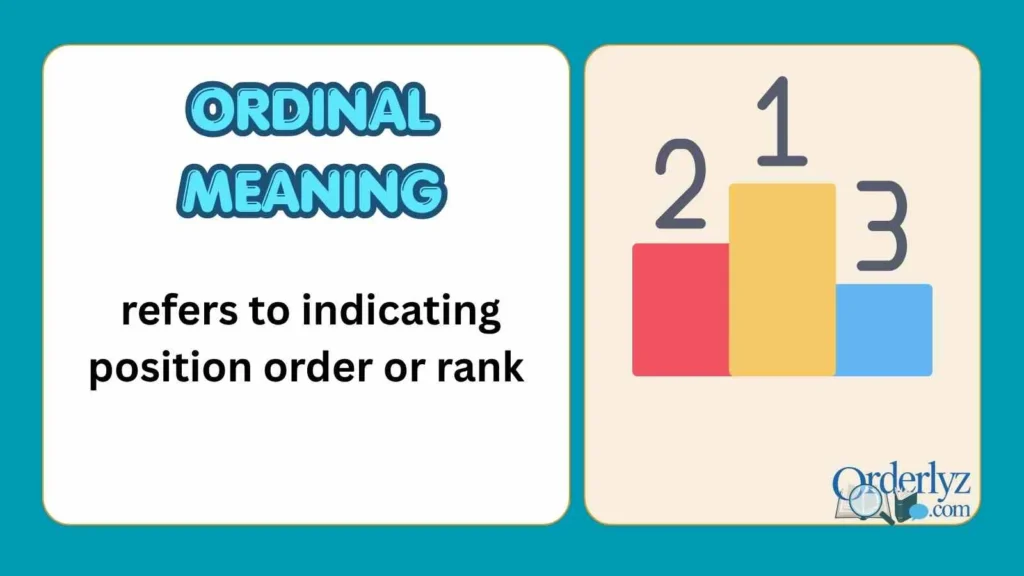
Imagine you’re watching a race. One runner finishes first, another comes second, and another takes third place. Notice something? You’re not counting how many runners there are—you’re describing their positions.
That’s exactly where ordinal meaning comes into play.
The word “ordinal” appears in math textbooks, grammar lessons, data analysis, rankings, and even everyday conversations. Yet many people confuse ordinal numbers with regular counting numbers. Understanding the difference can make schoolwork easier, improve your communication skills, and help you better understand charts, statistics, and rankings.
Whether you’re a student, parent, teacher, English learner, or simply curious about language, this guide breaks down ordinal meaning in a clear and practical way.
Updated for 2026′ this resource covers definitions, examples, history, common mistakes, real-world applications, and frequently asked questions—all in one place.
What Does “Ordinal Meaning” Mean?
Quick Answer
Examples include:
- First
- Second
- Third
- Fourth
- Tenth
- Hundredth
Simple Definition
An ordinal number tells you which one something is rather than how many there are.
For example:
- There are five students in the room. (Cardinal number)
- Sarah is the first student to arrive. (Ordinal number)
Pronunciation
Ordinal is pronounced:
OR-duh-nuhl
Phonetic spelling:
/ˈɔːr.dɪ.nəl/
Origin of the Word
The term “ordinal” comes from the Latin word “ordinalis”, which means “relating to order”. The root word ‘ordo’ means arrangement, rank, or sequence.
For centuries, the concept has been used in mathematics, grammar, religion, and record-keeping to describe positions and ranks rather than quantities.
Today, ordinal numbers remain essential in education, data analysis, surveys, rankings, and everyday communication.
Understanding Ordinal Numbers
Ordinal numbers answer questions like the following:
- Which place?
- Which position?
- What rank?
- What order?
Common Ordinal Numbers
| Cardinal Number | Ordinal Number |
|---|---|
| 1 | First |
| 2 | Second |
| 3 | Third |
| 4 | Fourth |
| 5 | Fifth |
| 6 | Sixth |
| 7 | Seventh |
| 8 | Eighth |
| 9 | Ninth |
| 10 | Tenth |
Written Forms
Ordinal numbers are often written using abbreviations:
| Number | Ordinal Form |
|---|---|
| 1 | 1st |
| 2 | 2nd |
| 3 | 3rd |
| 4 | 4th |
| 11 | 11th |
| 21 | 21st |
| 32 | 32nd |
These forms appear frequently in dates, rankings, and addresses.
How to Use “Ordinal” Correctly
Unlike internet slang, ‘ordinal’ isn’t a trendy social media expression. It’s a formal academic and grammatical term used across many contexts.
In Mathematics
Ordinal numbers describe position.
Examples:
- She finished first.
- The book is on the third shelf.
- Turn to the fifth page.
In Grammar
Ordinal words act as adjectives.
Examples:
- My second attempt was successful.
- The fourth chapter is the longest.
In Dates
Dates commonly use ordinal forms.
Examples:
- July 4th
- August 21st
- December 31st
In Rankings
Ordinal numbers are essential for competitions.
Examples:
- First place
- Second place
- Third place
Real-Life Examples of Ordinal Meaning
Example 1: School Ranking
Teacher: “Who scored the highest grade?”
Student: “Emma finished first in the class.”
Meaning: ‘First’ indicates Emma’s position among all students.
Example 2: Sports Competition
Announcer: “David came second in the marathon.”
Meaning: David’s rank was number two.
Example 3: Following Instructions
Recipe:
- Mix ingredients.
- Bake the mixture.
- Let it cool.
You might say:
“The second step is baking.”
Meaning: ‘Second’ identifies the order of the action.
Example 4: Book Organization
“The answer appears in the fifth chapter.”
Meaning: Fifth identifies the chapter’s position.
Example 5: Workplace Achievement
“Our team ranked first in customer satisfaction.”
Meaning: The team achieved the highest position.
Common Mistakes & Misunderstandings
1. Confusing Ordinal and Cardinal Numbers
Many people think they are the same.
Incorrect thinking:
- Five and fifth mean the same thing.
Correct understanding:
- Five = quantity.
- Fifth = position.
2. Using Wrong Suffixes
People sometimes write:
- 2nd ❌
- 3rd ❌
Correct forms:
- 2nd ✅
- 3rd ✅
3. Mixing Quantity With Rank
Example:
“There were the first students in the room.”
Incorrect because it first shows position, not quantity.
Correct:
“There were five students in the room.”
Generational Differences
Younger students usually encounter ordinal numbers in elementary school.
Adults may recognise them mostly through:
- Sports rankings
- Competition results
- Dates
- Business reports
The concept remains universal across generations.
Ordinal Meaning Across Different Fields
Mathematics
Ordinal numbers identify order within a sequence.
Examples:
- First term
- Second term
- Tenth element
Statistics
Ordinal data represents ranked categories.
Example satisfaction survey:
- Very Poor
- Poor
- Average
- Good
- Excellent
These categories have an order but not equal numerical distances.
Education
Teachers use ordinal concepts constantly.
Examples:
- First grade
- Second semester
- Third question
Business
Companies use ordinal rankings for:
- Performance reports
- Employee rankings
- Sales positions
Everyday Life
You use ordinal numbers more than you may realise:
- Floors in buildings
- Birthdays
- Race results
- Seating arrangements
- Calendar dates
Ordinal vs Cardinal Numbers
This is one of the most searched questions related to ordinal meaning.
| Feature | Cardinal Numbers | Ordinal Numbers |
|---|---|---|
| Purpose | Show quantity | Show position |
| Examples | One, Two, Three | First, Second, Third |
| Question Answered | How many? | Which one? |
| Usage | Counting | Ranking |
| Example | Three apples | Third apple |
Easy Memory Trick
Think:
- Cardinal = Count
- Ordinal = Order
That simple distinction helps most learners remember the difference instantly.
Related Terms, Concepts & Alternatives
| Term | Meaning |
|---|---|
| Cardinal Number | Shows quantity |
| Rank | Position in a list |
| Sequence | Ordered arrangement |
| Position | Location in order |
| Hierarchy | Structured ranking system |
| Classification | Grouping items by category |
| Numerical Order | Arrangement based on numbers |
| Index | Position indicator |
| Order Number | Sequence identifier |
| Ranking | Relative position |
Suggested Internal Links
- Cardinal Number Meaning
- Sequence Meaning
- Hierarchy Meaning
- Ranking Meaning
- Numerical Order Explained
FAQs:
What does ‘ordinal’ mean in maths?
In mathematics, ‘ordinal’ refers to a number that shows position or order within a sequence. Examples include first, second, and tenth. Ordinal numbers describe rank rather than quantity.
What is an example of an ordinal number?
Examples include first, second, third, fourth, fifth, and tenth. These numbers indicate where something appears in a sequence.
Is ’21st’ an ordinal number?
Yes. ‘Twenty-first’ (21st) is an ordinal number because it indicates position rather than quantity.
Why are ordinal numbers important?
Ordinal numbers help people understand order, rank, sequence, and position. They are essential in education, sports, business, statistics, and daily communication.
What is ordinal data?
Ordinal data is a type of data that has a meaningful order or ranking but does not necessarily have equal intervals between categories.
Are dates ordinal numbers?
Yes. Dates such as 1st, 2nd, and 15th use ordinal forms because they indicate a position within a month.
How do children learn ordinal numbers?
Children usually learn ordinal numbers through counting activities, races, classroom exercises, calendars, and sequencing tasks.
Conclusion:
Understanding ordinal meaning is surprisingly useful because it appears everywhere—from classroom lessons and competition rankings to dates on your calendar and reports at work.
The key idea is simple: ordinal numbers show position or order, while cardinal numbers show quantity. Once you understand that distinction, concepts like ‘first’, ‘second’, ‘third’, and ‘twentieth’ become easy to recognise and use correctly.
The next time you hear someone mention first place, the second chapter, or the 25th day of the month, you’ll immediately recognise the power of ordinal numbers in everyday communication.
Explore related terms like ‘cardinal number meaning‘, ‘sequence meaning’, and ‘ranking meaning’ to build an even stronger understanding of how numbers organise the world around us.

Hi, I’m Sophia Brownn, the creator behind Orderlyz.com, where words, meanings, and expressions are made simple, clear, and easy to understand.
I believe language shouldn’t feel confusing or overwhelming. In a world where new slang, trends, and expressions appear every day, my goal is to bring order to the chaos. I break down meanings in a way that feels natural, quick, and actually useful in real life conversations.