Ever seen someone agree with everything their boss says even when it makes zero sense? Or maybe a friend suddenly acts overly polite just to impress someone? That’s where the term ‘kowtow’, meaning, comes into play.
In today’s world of fast messaging, workplace dynamics, and social media interactions, understanding nuanced words like “kowtow” helps you decode behaviour—and express yourself more precisely. It’s not just an old-fashioned term; it’s still surprisingly relevant in modern conversations.
This guide (updated for 2026) breaks down everything you need to know: the exact definition, where it came from, how to use it naturally, and how to avoid sounding awkward or outdated. By the end, you’ll not only understand the meaning of ‘kowtow’ but also confidently use it in real-life situations.
What Does “Kowtow” Mean? (Definition + Origin)
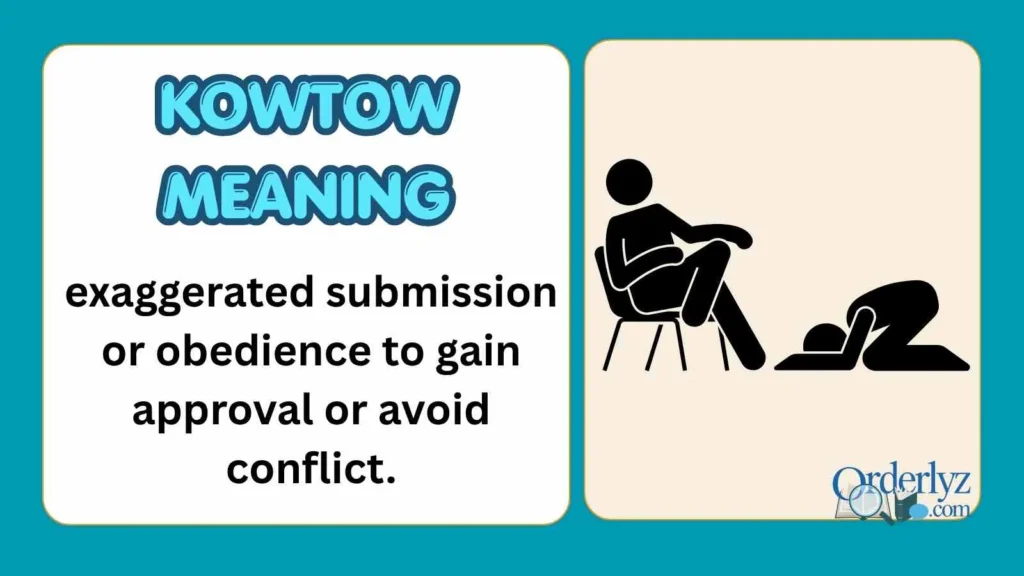
‘Kowtow’ means to act in an overly submissive, obedient, or deferential way toward someone—often excessively or insincerely.
Quick Answer:
Kowtow = exaggerated submission or obedience to gain approval or avoid conflict.
Origin of the Word
The term comes from the Chinese word kòutóu (叩头), which literally means “knock the head”. It referred to a traditional act of deep respect where a person would kneel and bow so low that their forehead touched the ground.
Evolution of Meaning
- Historical use: A respectful physical gesture in imperial China
- Modern use: A metaphor for excessive flattery or submission
- Today: Often carries a slightly negative tone, implying lack of independence or dignity
Pronunciation Guide
kowtow → /ˈkaʊ.taʊ/
Sounds like ‘kowtow’.
How to Use “Kowtow” Correctly in Texts & Chat
Using kowtow correctly depends on tone and context. It’s not slang, but it fits well in modern casual and semi-formal communication.
Tone & Context
- Usually critical or disapproving
- Can be sarcastic or humorous
- Rarely used as a compliment
Where You’ll See It
- Workplace conversations
- Social commentary
- Online debates
- Group chats (especially when joking about someone being a “people pleaser”)
Platform-Specific Usage
- WhatsApp / SMS: “Stop kowtowing to him lol.”
- Instagram: Used in captions criticizing behavior
- Twitter/X: Common in political or opinionated posts
- Reddit: Often used in discussions about authority or power dynamics
- Discord: Casual debates or gaming hierarchy jokes
When NOT to Use It
- Formal business emails
- Academic writing (unless discussing history or linguistics)
- Conversations where tone may be misunderstood
Formatting Tips
- Usually lowercase: kowtow
- No abbreviation form
- Can pair with emojis for tone: 😅 🙄
Real Conversation Examples Using “Kowtow”
1. Between Friends
A: Why are you agreeing with everything he says?
B: I’m not!
A: Dude, you’re totally kowtowing.
👉 Emotion: Light teasing, calling out submissive behaviour.
2. In a Workplace Chat
Manager: Let’s work this weekend again.
Employee 1: Sure! No problem!
Employee 2 (DM): You don’t have to kowtow every time…
👉 Emotion: Subtle criticism, frustration.
3. Dating Scenario
A: He changed all his opinions just to match hers.
B: Sounds like he’s kowtowing hard.
👉 Emotion: Judgement, disbelief.
4. Family Situation
Parent: Why do you always listen to your cousin?
Teen: I’m not kowtowing; I just agree sometimes!
👉 Emotion: Defensive tone.
5. Gaming / Online Community
Player 1: Everyone just follows the top player’s strategy.
Player 2: Yeah, they just kowtow instead of thinking.
👉 Emotion: Criticism of lack of independence.
Common Mistakes & Misunderstandings
1. Thinking It Means Respect
Kowtow isn’t simple respect—it implies excessive or forced submission.
2. Using It Positively
Saying “He kowtows well” sounds awkward or wrong. It usually carries a negative vibe.
3. Generational Confusion
- Gen Z: May not use it often, but understands it in context
- Older generations: More familiar with the term
- Some may confuse it with “being polite” rather than submissive
4. Cultural Misinterpretation
In its original context, ‘kowtow’ was respectful—not negative. Modern English flipped the tone slightly.
“Kowtow” Across Different Platforms & Demographics
Generational Usage
- Gen Z: Uses it occasionally, often humorously
- Millennials: More likely to use it in workplace or social commentary
- Older users: Use it more traditionally
Platform Trends
- TikTok: Rare, but appears in commentary videos
- Instagram: Used in captions criticizing behavior
- Reddit: Frequent in discussions about authority
- Twitter/X: Common in political debates
Formality Level
- Informal to semi-formal
- Not suitable for professional documents
Is It Safe for Work?
- Yes—but context matters
- Avoid if it sounds accusatory
Related Slang, Abbreviations & Alternatives
| Term | Meaning |
|---|---|
| People-pleaser | Someone who tries too hard to satisfy others |
| Suck up | Informal version of kowtow |
| Brown-nose | Excessive flattery for gain |
| Bootlick | Harsh slang for submissive behavior |
| Yes-man | Always agrees with authority |
| Grovel | Beg or act overly submissive |
| Submit | Neutral version without negative tone |
| Obey | Follow orders (neutral) |
| Defer | Yield respectfully |
| Follow blindly | Lack of independent thinking |
👉 Learn more about related terms like “yes-man” or “brown-nose” to deepen your understanding of social dynamics.
FAQs:
What does kowtow mean in simple terms?
‘Kowtow’ means acting overly submissive or obedient towards someone, often more than necessary. It usually implies trying too hard to please or avoid conflict.
Is kowtow a negative word?
Yes, in most modern contexts it has a negative tone. It suggests weakness, lack of independence, or insincere behaviour.
How do you use kowtow in a sentence?
Example: “He refused to kowtow to pressure from his peers.” It shows someone resisting submission.
Where did the word ‘kowtow’ come from?
It comes from a Chinese ritual where people bowed deeply as a sign of respect. The modern meaning evolved into a metaphor for excessive submission.
Is kowtow still used today?
Yes, especially in discussions about workplace behaviour, politics, and social dynamics. It’s less common in casual slang but still widely understood.
Conclusion:
Understanding the meaning of ‘kowtow’ gives you a sharper lens to read people’s behaviour. It’s not just about respect—it’s about too much of it, often with a hidden motive.
You’ll spot it everywhere now: in offices, relationships, and even online debates. And once you recognise it, you can decide whether it’s smart diplomacy—or just unnecessary submission.
Use the word carefully. It’s powerful, slightly critical, and says more than you might think.
👉 Got a favourite slang or phrase you want decoded next? Drop it below and keep exploring modern language like a pro.

Hi, I’m Sophia Brownn, the creator behind Orderlyz.com, where words, meanings, and expressions are made simple, clear, and easy to understand.
I believe language shouldn’t feel confusing or overwhelming. In a world where new slang, trends, and expressions appear every day, my goal is to bring order to the chaos. I break down meanings in a way that feels natural, quick, and actually useful in real life conversations.