Have you ever achieved something you worked towards for years and felt a deep sense of fulfilment that lasted far longer than the excitement of buying a new gadget or getting a few extra likes online?
That feeling gets surprisingly close to the eudaimonia meaning discussed by philosophers for more than two thousand years.
In a world obsessed with instant gratification, productivity hacks, and quick dopamine hits, eudaimonia offers a different perspective. It asks a powerful question: What does it mean to truly live well?
Unlike ordinary happiness, eudaimonia focuses on purpose, character, growth, and living according to your best values. It’s a concept that has influenced psychology, self-improvement, ethics, leadership, education, and even modern wellness movements.
In this guide, you’ll learn the true meaning of eudaimonia, where the idea originated, how Aristotle explained it, how it’s used today, and practical examples that make this ancient concept surprisingly relevant in modern life.
What Does “Eudaimonia” Mean?
Quick Answer
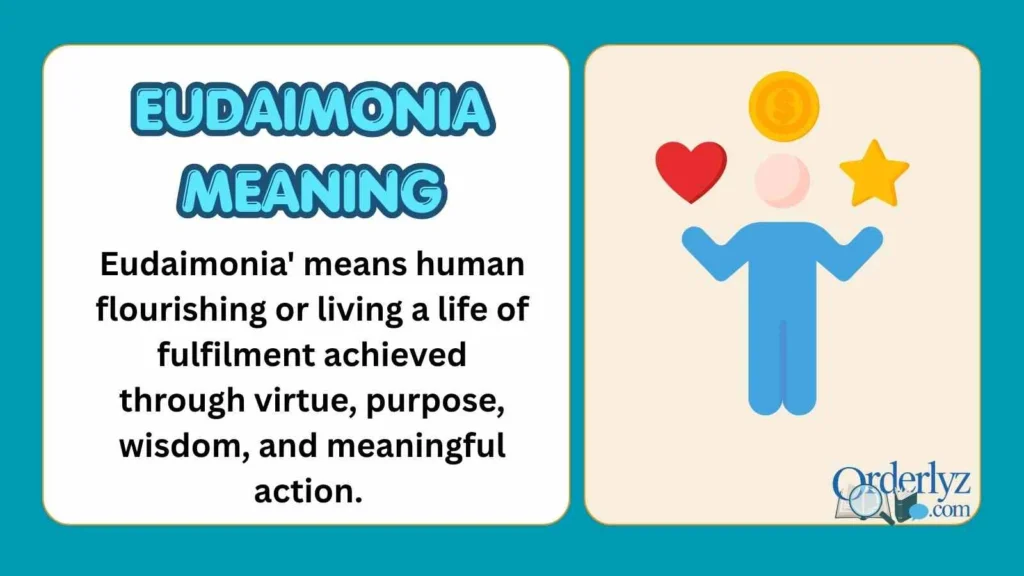
‘Eudaimonia’ means human flourishing or living a life of fulfilment achieved through virtue, purpose, wisdom, and meaningful action. It is often associated with Aristotle’s philosophy and is considered a deeper form of well-being than simple happiness.
Definition
The term ‘eudaimonia’ comes from Ancient Greek philosophy and refers to the highest form of human well-being.
Rather than describing a temporary feeling, it represents a complete life lived excellently and meaningfully.
Many scholars translate ‘eudaimonia’ as the following:
- Human flourishing
- True fulfillment
- Living well
- Well-being
- The good life
- Meaningful flourishing
Pronunciation
Eudaimonia is commonly pronounced
yoo-dye-MOH-nee-uh
Phonetic spelling:
yoo-dai-MOH-nee-uh
Origin and History
The word comes from Ancient Greek:
- eu = good
- daimon = spirit, guiding force, or inner self
Originally, eudaimonia suggested being guided by a good spirit or living in a fortunate state.
Ancient Greek thinkers explored the concept extensively, but Aristotle made it the centrepiece of his ethical philosophy.
In his famous work, Nicomachean Ethics, Aristotle argued that every human action ultimately aims towards some good, and the highest good is eudaimonia.
How to Use “Eudaimonia” Correctly in Texts & Conversation
Unlike internet slang or texting abbreviations, eudaimonia is primarily used in:
- Philosophy discussions
- Psychology research
- Self-improvement content
- Academic writing
- Leadership coaching
- Wellness and mindfulness conversations
Appropriate Contexts
You might use the term when discussing:
- Purpose in life
- Personal growth
- Long-term fulfillment
- Ethical decision-making
- Character development
Example Sentences
- “The book argues that success without eudaimonia feels empty.”
- “She focused on personal growth rather than short-term pleasure, pursuing eudaimonia instead.”
- “Many positive psychologists connect well-being with eudaimonia.”
When Not to Use It
Because it’s a philosophical term, using it casually may confuse some audiences.
For example:
❌ “I got pizza today. Total eudaimonia.”
✅ “Volunteering gave him a sense of eudaimonia and purpose.”
Why Eudaimonia Is Different From Happiness
One of the biggest misconceptions involves treating eudaimonia and happiness as identical concepts.
They overlap, but they’re not the same.
| Happiness | Eudaimonia |
|---|---|
| Often emotional | More holistic |
| Can be temporary | Long-term |
| Based on feelings | Based on flourishing |
| May come from pleasure | Comes from purpose |
| Moment-focused | Life-focused |
Imagine two people:
Person A: Wins money, buys luxury items, and feels excited for a few weeks.
Person B: Builds strong relationships, develops skills, contributes to society, and lives according to personal values.
Aristotle would likely argue that Person B is closer to eudaimonia.
Real-Life Examples of Eudaimonia
Understanding the concept becomes easier through everyday examples.
Example 1: The Dedicated Teacher
A teacher spends decades helping students succeed.
The work isn’t always easy or glamorous, but it creates meaning and purpose.
Eudaimonic element: Contribution and personal excellence.
Example 2: The Marathon Runner
Training requires discipline, setbacks, and persistence.
Crossing the finish line provides more than pleasure—it reflects growth and achievement.
Eudaimonic element: Developing virtue and resilience.
Example 3: Caring for Family
Parents often sacrifice comfort and convenience for their children.
While stressful at times, the experience can bring deep fulfilment.
Eudaimonic element: Meaningful responsibility.
Example 4: Building a Craft
A musician practices for years, not simply for applause but to master an art form.
Eudaimonic element: Pursuing excellence.
Example 5: Community Service
Volunteering may not always feel fun, but it can create a profound sense of purpose.
Eudaimonic element: Serving something larger than yourself.
Common Mistakes and Misunderstandings
Mistake #1: Thinking It Means Constant Happiness
Eudaimonia does not require feeling happy every moment.
Challenges, failures, and difficult experiences can still contribute to a flourishing life.
Mistake #2: Equating It With Wealth
Money can support well-being, but Aristotle did not believe wealth alone creates eudaimonia.
Many wealthy people feel unfulfilled despite financial success.
Mistake #3: Assuming It’s Purely Philosophical
Modern psychology frequently uses the concept.
Researchers often distinguish between the following:
- Hedonic well-being (pleasure)
- Eudaimonic well-being (meaning and growth)
Eudaimonia Across Different Platforms & Demographics
Academic Communities
Universities and philosophy departments use the term frequently when discussing ethics and human flourishing.
Psychology and Wellness Spaces
Positive psychology has revived interest in eudaimonia.
Many researchers argue that meaning and purpose contribute significantly to long-term well-being.
Social Media
On platforms like:
- TikTok
- YouTube
The concept often appears in content about:
- Self-development
- Mindfulness
- Stoicism
- Purpose-driven living
- Mental wellness
Younger Generations
Gen Z and Millennials increasingly encounter eudaimonia through the following:
- Productivity creators
- Philosophy channels
- Wellness influencers
- Book summaries
The term has become a popular alternative to purely success-focused narratives.
Related Terms, Concepts & Alternatives
Understanding related concepts helps clarify the eudaimonia meaning.
| Term | Meaning |
|---|---|
| Flourishing | Thriving as a person |
| Well-being | Overall quality of life |
| Purpose | A meaningful direction in life |
| Virtue | Moral excellence |
| Fulfillment | Deep satisfaction from meaningful pursuits |
| Self-actualization | Reaching one’s potential |
| Stoicism | Philosophy emphasizing virtue and wisdom |
| Hedonism | Focus on pleasure and enjoyment |
| Mindfulness | Awareness of the present moment |
| Meaningful living | Life guided by values and purpose |
Synonyms
- Human flourishing
- Fulfillment
- Thriving
- Living well
- Meaningful existence
Near Opposites
- Emptiness
- Aimlessness
- Stagnation
- Meaninglessness
- Unfulfilment
Eudaimonia in Modern Psychology
One reason interest in eudaimonia continues to grow is its connection to modern psychological research.
Psychologists studying well-being often separate two approaches:
Hedonic Well-Being
Focuses on:
- Pleasure
- Comfort
- Positive emotions
- Enjoyment
Eudaimonic Well-Being
Focuses on:
- Meaning
- Growth
- Purpose
- Relationships
- Personal development
Many experts now argue that the most satisfying lives combine both approaches rather than relying solely on pleasure.
FAQs:
What does eudaimonia mean in simple words?
Eudaimonia means living a fulfilling, meaningful, and flourishing life. It goes beyond temporary happiness and focuses on becoming the best version of yourself through purpose, virtue, and personal growth.
Is eudaimonia a type of happiness?
Not exactly. Happiness often describes emotions, while eudaimonia describes an entire way of living well. Someone can experience challenges and still achieve eudaimonia through meaningful actions and personal development.
Why is eudaimonia important?
The concept encourages people to pursue long-term fulfilment instead of chasing only short-term pleasure. It emphasises purpose, character, wisdom, and meaningful relationships.
What did Aristotle say about eudaimonia?
Aristotle believed eudaimonia was the highest human good. According to his philosophy, people achieve it by practising virtue, developing their abilities, and living according to reason.
How is eudaimonia used today?
Today, eudaimonia appears in philosophy, psychology, leadership studies, education, wellness programmes, and self-improvement discussions. It remains one of the most influential ideas about what it means to live a good life.
Is eudaimonia the same as success?
No. Success often focuses on external achievements such as money, status, or recognition. Eudaimonia focuses on internal flourishing, meaningful living, and developing excellent character.
Conclusion:
The true eudaimonia meaning extends far beyond simple happiness. It describes a life marked by purpose, virtue, growth, and meaningful contribution.
While pleasure and comfort matter, Aristotle argued that genuine fulfilment comes from becoming the best version of yourself and living according to your values. More than two thousand years later, that idea remains remarkably relevant.
Whether you’re exploring philosophy, psychology, or personal development, eudaimonia offers a powerful reminder: a good life isn’t measured only by how good you feel today—it’s measured by how well you live overall.
What does a flourishing life look like to you? Share your thoughts and explore more fascinating meaning guides below

Hi, I’m Sophia Brownn, the creator behind Orderlyz.com, where words, meanings, and expressions are made simple, clear, and easy to understand.
I believe language shouldn’t feel confusing or overwhelming. In a world where new slang, trends, and expressions appear every day, my goal is to bring order to the chaos. I break down meanings in a way that feels natural, quick, and actually useful in real life conversations.