You’ve probably heard the word “premeditation” in crime documentaries, courtroom dramas, or viral true-crime TikToks. Usually, someone says it in a super serious voice right before dramatic background music kicks in.
But what does premeditation’s meaning actually involve?
A lot of people assume it simply means “thinking really hard” about something. In reality, the term has a much more specific meaning — especially in law. Premeditation often determines whether an act was impulsive or carefully planned, and that distinction can completely change how courts, the media, and society view a situation.
The word also appears outside legal settings. People casually use “premeditated” online to describe anything from revenge texting to intentionally showing up late to a group dinner. Internet humour really stretches vocabulary sometimes.
This guide breaks down the full meaning of premeditation, its legal importance, modern usage, real examples, common misunderstandings, and how the term appears across social media and pop culture.
Updated for 2025 with current legal context and modern digital language trends.
## What Does “Premeditation” Mean? (Definition + Origin)
‘Premeditation’ means thinking about or planning an action before carrying it out.
The word is most commonly associated with criminal law, where it describes deliberate planning before committing a crime.
> Quick Answer:
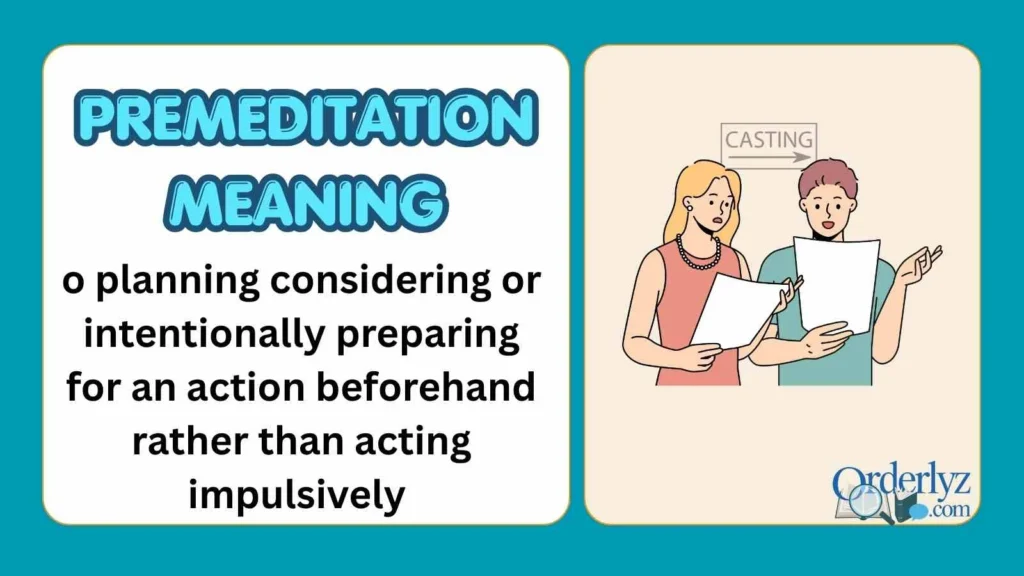
‘Premeditation’ meaning refers to planning, considering, or intentionally preparing for an action beforehand rather than acting impulsively.
Word Origin & Etymology
The term comes from the Latin roots:
- pre- = before
- ‘meditari’ = to think or reflect
So the literal meaning is basically the following:
“Thinking beforehand.”
The word has existed in English for centuries, but modern media and legal systems made it especially common in discussions about criminal intent.
How the Meaning Evolved
Originally, premeditation could refer to any thoughtful preparation.
Today, most people immediately connect the word with the following:
- criminal law
- first-degree murder
- planned actions
- intentional behavior
That legal association became deeply embedded through:
- courtroom TV shows
- true-crime podcasts
- documentaries
- internet crime discussions
Pronunciation Guide
Most people pronounce it like this:
“Pre-med-i-TA-tion”
Yes, it sounds dramatic. Hollywood definitely helped with that.
## Premeditation Meaning in Law
This is where the term becomes especially important.
In criminal law, premeditation often helps determine whether someone planned a crime before committing it.
That distinction can affect:
- criminal charges
- sentencing severity
- jury perception
- legal outcomes
Premeditated vs Impulsive Actions
| Premeditated Action | Impulsive Action |
|---|---|
| Planned ahead of time | It happens suddenly |
| Involves deliberate thought | Emotional reaction |
| Often legally more serious | Usually less calculated |
| Shows intent beforehand | Little or no prior planning |
Does Premeditation Require Long-Term Planning?
Surprisingly, not always.
Many people think premeditation means planning something for weeks or months. Legally, even a short period of deliberate thought may count.
In some cases, courts have ruled that premeditation can happen within minutes or even seconds if someone consciously decides and prepares to act.
That’s why legal definitions get complicated fast.
Why Courts Care About Premeditation
Premeditation helps establish the following:
- intent
- awareness
- deliberation
- conscious decision-making
This matters especially in homicide cases involving:
- first-degree murder
- deliberate intent
- planned violence
Important Note
Premeditation itself is not illegal.
People premeditate harmless things every day:
- surprise parties
- vacation plans
- business strategies
- prank texts
- elaborate proposals
The legal issue arises when planning connects to criminal acts.
## How to Use “Premeditation” Correctly in Everyday Conversation
Outside courtrooms, people use “premeditated” in a more casual and exaggerated way online.
Usually for humour.
Casual Internet Usage
Example:
“That was a premeditated unfollow.”
Translation:
“You absolutely planned that drama.”
Social media users love using legal-sounding language to make ordinary situations sound hilariously intense.
Common Everyday Contexts
People use “premeditated” to describe the following:
- planned revenge
- intentional ghosting
- strategic social moves
- calculated decisions
- obvious setups
Platform-Specific Usage
TikTok
Common in:
- relationship drama videos
- “petty revenge” stories
- true-crime edits
- meme commentary
X (Twitter)
Often used sarcastically:
“Deleting my message after they read it was fully premeditated.”
More serious discussions appear in:
- legal advice communities
- crime discussions
- philosophy threads
- psychology debates
Used in captions and memes for dramatic effect.
Because apparently everything online now needs cinematic energy.
When NOT to Use It
Avoid using “premeditation” casually when discussing the following:
- real criminal cases
- active legal situations
- sensitive tragedies
The term carries significant legal and emotional weight.
## Real Conversation Examples Using “Premeditation”
Between Friends
Chris: “You brought screenshots to the argument?”
Maya: “Absolutely. This was premeditated.”
Meaning: Humorous acknowledgement of intentional preparation.
Dating Scenario
Jake: “You accidentally liked their photo from 2019?”
Emma: “Nothing accidental about it.”
Meaning: Suggests deliberate online behaviour.
Work Chat
Coworker: “You scheduled the email for exactly 8:01 am?”
Manager: “Strategic timing”.
Meaning: Shows calculated planning, though harmlessly.
Gaming Chat
Player 1: “You trapped me on purpose.”
Player 2: “Every move was premeditated.”
Meaning: Competitive planning and strategy.
Family Conversation
Mom: “You cleaned your room before asking for money?”
Teen: “Okay, maybe slightly premeditated.”
Meaning: Jokingly admits manipulation or planning.
## Common Mistakes & Misunderstandings
1. Thinking Premeditation Always Means Crime
Not true.
‘Premeditation’ simply means planning beforehand. The word ‘criminal’ becomes criminal only when tied to illegal acts.
2. Assuming It Requires Long-Term Planning
Legally, premeditation may occur very quickly.
That surprises many people because movies often portray it as elaborate long-term plotting.
3. Using It Interchangeably With “Intent”
Intent and premeditation overlap, but they aren’t identical.
Someone can intend to act suddenly without extensive planning.
Premeditation specifically involves prior thought or deliberation.
Generational Differences
Gen Z
Uses “premeditated” sarcastically online:
“Premeditated side-eye.”
Internet humour turns legal terminology into comedy surprisingly fast.
Millennials
It’s often used in meme culture and true-crime discussions.
Older Generations
Usually associate the word ‘strictly’ with criminal law.
Cultural Differences
Crime media popularity affects familiarity with the term.
Countries with strong true-crime entertainment cultures tend to use “premeditated” more casually online.
## “Premeditation” Across Different Platforms & Demographics
TikTok
True-crime TikTok massively increased public familiarity with legal terminology like the following:
- premeditation
- motive
- alibi
- accomplice
Sometimes accurately. Sometimes… not so much.
YouTube
Legal analysis channels frequently explain the following:
- premeditated murder
- criminal intent
- courtroom strategy
- famous cases
Discussions tend to be more analytical and detailed, especially in the following:
- law communities
- philosophy forums
- crime analysis threads
Is premeditation formal or informal?
The word itself is formal.
But internet culture often uses it informally or humorously.
Is It Safe for Work?
Usually yes in ordinary discussion.
But avoid joking about criminal premeditation in professional environments. Context matters a lot.
## Related Slang, Abbreviations & Alternatives
| Term | Meaning |
|---|---|
| Intent | Purpose or aim behind an action |
| Motive | Reason for doing something |
| Deliberate | Done intentionally |
| Calculated | Carefully planned |
| Spontaneous | Done without planning |
| Impulsive | Acting suddenly |
| Alibi | Proof someone was elsewhere |
| Conspiracy | Secret planning between people |
| First-degree murder | Intentional and premeditated killing |
| Mens rea | Legal term for criminal intent |
Related Search Opportunities
Readers often also search:
- “difference between intent and premeditation”
- “premeditated meaning in law”
- “first degree murder explained”
- “legal terms used online”
- “crime documentary vocabulary”
Synonyms
Common alternatives include:
- planned
- deliberate
- intentional
- strategic
- calculated
Antonyms
Opposites include:
- impulsive
- spontaneous
- accidental
- unplanned
FAQs:
### What does premeditation mean?
‘Premeditation’ means planning, thinking about, or deliberately considering an action before carrying it out.
### What is a premeditated crime?
A premeditated crime involves prior planning or deliberate intent rather than an impulsive or emotional reaction.
### Does premeditation always involve murder?
No. While the term commonly appears in homicide cases, premeditation can apply to many planned actions, legal or illegal.
### How long does premeditation take legally?
There’s no universal time requirement. In some legal systems, premeditation may occur within a very short period if deliberate thought is proven.
### Is premeditation the same as intent?
Not exactly. ‘Intent’ means wanting a result, while ‘premeditation’ involves thinking or planning beforehand.
### Why do people use “premeditated” jokingly online?
Internet culture often exaggerates dramatic words for humour. Calling something “premeditated” makes ordinary behaviour sound suspiciously strategic.
Conclusion:
The real premeditation meaning is much broader than most people realise.
At its core, the word simply refers to thinking or planning before acting. But in legal settings, premeditation can dramatically affect how actions are judged and prosecuted.
Online culture added another layer by turning the term into meme-worthy shorthand for calculated behaviour, strategic drama, and intentionally chaotic decisions.
That mix of legal seriousness and internet humour explains why the word appears everywhere from courtroom documentaries to TikTok captions.
Have you seen another legal term taking over internet slang lately? Drop it in the comments and compare notes with fellow true-crime and language nerds.

Hi, I’m Sophia Brownn, the creator behind Orderlyz.com, where words, meanings, and expressions are made simple, clear, and easy to understand.
I believe language shouldn’t feel confusing or overwhelming. In a world where new slang, trends, and expressions appear every day, my goal is to bring order to the chaos. I break down meanings in a way that feels natural, quick, and actually useful in real life conversations.