Ever come across the term ‘nondenominational’ and wondered what it actually means? Maybe you saw it describing a church, a school, or even someone’s beliefs—and it left you slightly confused.
You’re not alone.
The phrase ‘nondenominational meaning’ has become increasingly common, especially as more people move away from traditional labels and embrace flexible identities in religion and lifestyle. But here’s the catch: while the word sounds simple, its real-world usage can vary depending on context.
Updated for 2025, this guide breaks everything down in plain English. You’ll learn what nondenominational truly means, where it comes from, how to use it correctly, and how it shows up in everyday conversations.
Let’s decode it.
What Does “Nondenominational” Mean? (Definition + Origin)
Nondenominational means not connected to any specific religious denomination or formal sect.
It’s most often used in religious contexts, especially in Christianity, to describe churches or individuals who choose not to align with established groups like Catholic, Baptist, or Lutheran traditions.
Quick Answer:
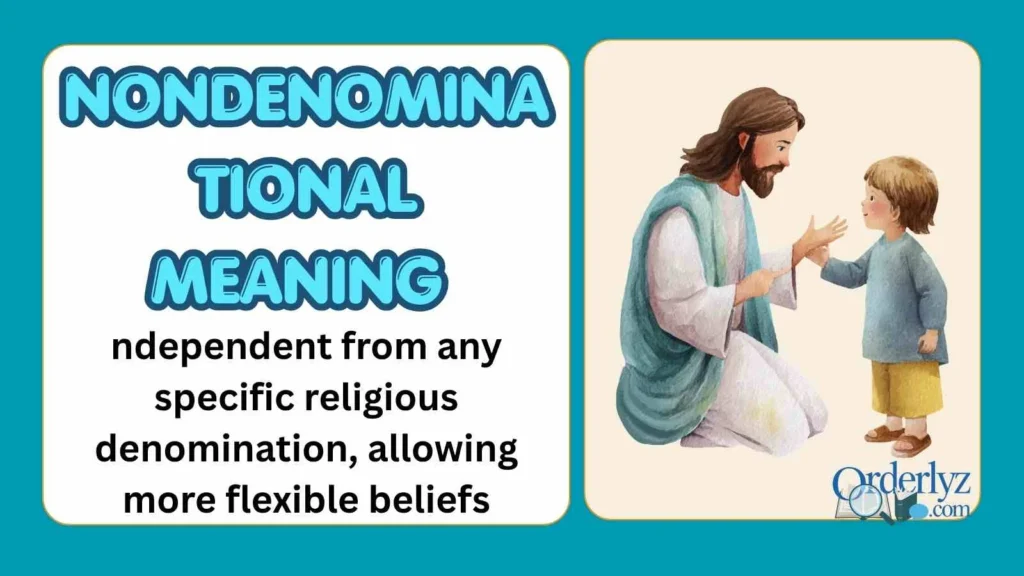
‘Nondenominational’ means independent from any specific religious denomination, allowing more flexible beliefs and practices.
Origin & Evolution
The term began gaining popularity in the 20th century, especially in the United States, as people sought more personalised and less institutional forms of worship.
Originally, religion was tightly organised into denominations. Over time, some groups felt restricted by rigid doctrines and started identifying as “nondenominational”.
Today, it’s widely used beyond religion—appearing in education, organisations, and even social identity discussions.
Pronunciation Guide
non-den-om-uh-NAY-shuh-nuhl
How to Use “Nondenominational” Correctly in Texts & Chat
Context & Tone
“Nondenominational” is typically
- Neutral in tone
- Informative
- Slightly formal but still conversational
It’s not slang, but it’s commonly used in everyday discussions.
Platform Usage
- WhatsApp/SMS:
“The school is nondenominational, so it welcomes everyone.” - Instagram Caption:
“Love how this community feels inclusive and non-denominational ❤️” - Twitter/X:
“More people are choosing nondenominational spaces for flexibility.” - Discord/Reddit:
Used in discussions about religion, philosophy, or identity.
When NOT to Use It
Avoid using it:
- In casual slang-heavy chats where simpler words work better
- As a replacement for “non-religious” (they’re different)
Formatting Tips
- No abbreviation—always written fully
- Typically lowercase unless starting a sentence
- Can pair with neutral emojis like ✨ or 🤝 in casual contexts
Real Conversation Examples Using “Nondenominational”
Between Friends
A: “What kind of church do you go to?”
B: “It’s nondenominational—pretty relaxed.”
➡️ Conveys openness and flexibility.
In a Group Chat
Person 1: “Is the event religious?”
Person 2: “It’s nondenominational, so everyone’s welcome.”
➡️ Emphasises inclusivity.
Family Conversation
Parent: “What does that school teach?”
Teen: “It’s nondenominational, so no specific religion.”
➡️ Highlights neutrality.
Workplace Chat
Colleague: “Is this organisation faith-based?”
You: “Yes, but it’s nondenominational.”
➡️ Signals professionalism and neutrality.
Gaming/Online Community
User: “What’s the group about?”
Admin: “It’s a nondenominational space for open discussion.”
➡️ Suggests diversity of beliefs.
Common Mistakes & Misunderstandings
1. Thinking It Means “Non-Religious”
Not true. Many nondenominational groups are still deeply religious—they just avoid strict labels.
2. Assuming It Has No Beliefs
Nondenominational doesn’t mean “anything goes”. It often still follows core principles, especially in Christianity.
3. Generational Confusion
- Older generations may expect clear labels
- Younger people prefer flexible identities
4. Cultural Differences
In some countries, denominational identity is stronger, so “nondenominational” may feel unfamiliar.
How to Clarify
If someone looks confused, simply say:
“It means not tied to a specific religious group.”
“Nondenominational” Across Different Platforms & Demographics
Generational Usage
- Gen Z: Uses it to signal inclusivity and openness
- Millennials: Associate it with modern churches
- Older Adults: May view it as unconventional
Platform Trends
- TikTok: Often appears in discussions about faith journeys
- Instagram: Used in bios and captions
- Discord: Common in community descriptions
Formality Level
- Semi-formal
- Safe for work
- Appropriate in academic and professional settings
Popularity Trend
The term has grown alongside the rise of independent churches and personalised belief systems.
Related Slang, Abbreviations & Alternatives
| Term | Meaning |
|---|---|
| Interfaith | Involving multiple religions |
| Secular | Not connected to religion |
| Spiritual | Personal belief system without strict rules |
| Agnostic | Unsure about religious truth |
| Atheist | Does not believe in God |
| Inclusive faith | Welcoming all beliefs |
| Independent church | Self-governing religious group |
| Non-religious | No religious affiliation |
| Ecumenical | Promoting unity among religions |
FAQs:
What does ‘nondenominational’ mean in simple words?
It means not belonging to any specific religious group or denomination. It allows flexibility in beliefs and practices while still being religious in many cases.
Is nondenominational the same as Christian?
Often, yes. Most nondenominational churches are Christian, but they operate independently from traditional denominations.
Can someone be nondenominational personally?
Yes. A person can identify as nondenominational if they believe in faith but don’t follow a specific organised group.
Is ‘nondenominational’ formal or informal?
It’s considered neutral and works in both formal and casual conversations.
Why are nondenominational churches popular?
They offer flexibility, inclusivity, and a modern approach to worship, which appeals to younger generations.
Conclusion:
The nondenominational meaning is simple at its core but powerful in its impact. It represents independence from strict labels while still allowing meaningful beliefs to exist.
In today’s world, where flexibility and inclusivity matter more than ever, the term continues to grow in relevance. Whether you’re talking about churches, schools, or personal identity, understanding this concept helps you communicate more clearly.
And now—you won’t hesitate the next time you see it.
Curious about more modern terms like this? Drop your favourite word or phrase and keep exploring the language shaping our world.

Hi, I’m Sophia Brownn, the creator behind Orderlyz.com, where words, meanings, and expressions are made simple, clear, and easy to understand.
I believe language shouldn’t feel confusing or overwhelming. In a world where new slang, trends, and expressions appear every day, my goal is to bring order to the chaos. I break down meanings in a way that feels natural, quick, and actually useful in real life conversations.