Have you ever wondered why bees visit flowers, why forests support thousands of species, or why removing a single animal from an ecosystem can cause unexpected consequences? The answer lies in ecology, meaning one of the most important concepts in biology and environmental science.
Today, ecology affects nearly every conversation about climate change, conservation, sustainability, and biodiversity. Whether you’re a student researching a science project, a parent helping with homework, or simply curious about how nature works, understanding ecology provides a powerful lens through which to view the world.
Updated for 2025, this comprehensive guide explains the meaning of ecology in plain English, explores its origins, provides practical examples, clears up common misconceptions, and shows why ecology matters more than ever in the modern world.
What Does “Ecology Meaning” Mean?
Quick Answer
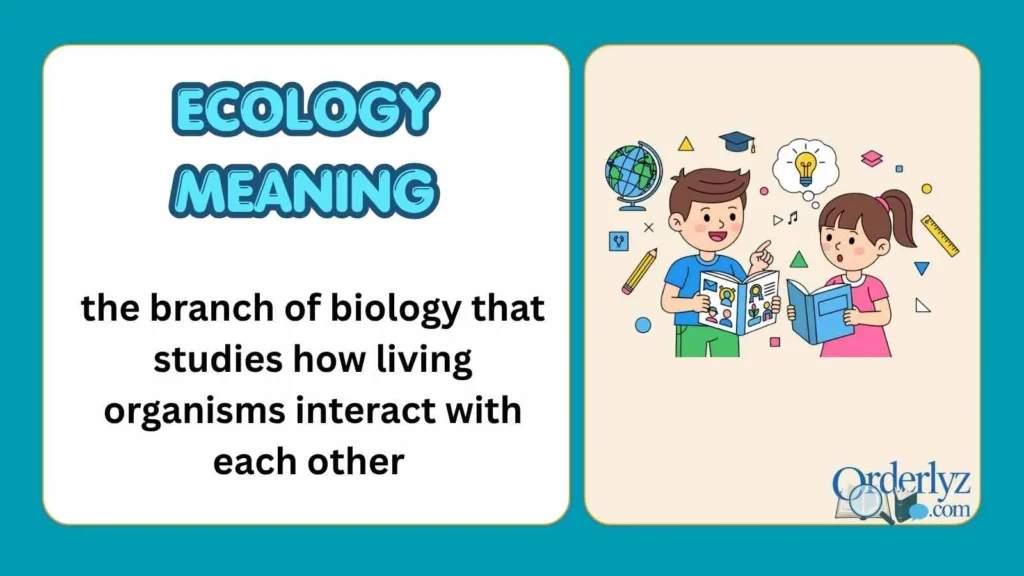
Ecology is the branch of biology that studies how living organisms interact with each other and with their physical environment.
In simple terms, ecology examines the relationships that connect all forms of life. These relationships include interactions between animals, plants, microorganisms, water, soil, climate, and even humans.
Pronunciation
Ecology: ih-KOL-uh-jee
Origin of the Word Ecology
The term “ecology” comes from the Greek words:
- Oikos meaning “house” or “home”
- Logos meaning “study”
Together, “ecology” literally means “the study of our home”, referring to the natural world and all its interconnected systems.
The word was popularised in the 19th century by German biologist Ernst Haeckel, who used it to describe the study of relationships between organisms and their surroundings.
How the Meaning Has Evolved
Originally, ecology focused mainly on plants and animals. Today, it encompasses:
- Climate science
- Conservation biology
- Human-environment interactions
- Sustainability studies
- Urban ecosystems
- Global environmental challenges
As environmental concerns have grown, ecology has become one of the most influential scientific disciplines worldwide.
How to Use “Ecology” Correctly in Conversations and Writing
Unlike internet slang, ecology is a formal scientific term. However, people often use it in everyday discussions about nature and the environment.
Common Contexts
You might hear ‘ecology’ used when discussing:
- Wildlife conservation
- Climate change
- Pollution
- Sustainable living
- Environmental education
- Ecosystem health
Correct Examples
“I’m studying ecology in my biology class.”
✅ “The ecology of coral reefs is incredibly complex.”
✅ “Understanding ecology helps us protect endangered species.”
Incorrect Usage
❌ “My room’s ecology is messy.”
Ecology refers to environmental relationships, not general conditions or organisation.
Professional vs Casual Use
| Setting | Appropriate? |
|---|---|
| School | Yes |
| Scientific Research | Yes |
| Environmental Discussions | Yes |
| Business Meetings | Sometimes |
| Casual Conversation | Yes |
Because ecology is an academic term, it works well in both formal and informal settings.
Real-World Examples of Ecology
Sometimes definitions feel abstract. Real examples make ecology easier to understand.
Example 1: Bees and Flowers
Scenario
Bee: Visits flower for nectar.
Flower: Receives pollination.
Ecological Meaning
Both organisms benefit from the relationship. Scientists call this mutualism.
Example 2: Wolves in a Forest
Scenario
Wolves hunt deer populations.
Ecological Meaning
Predators help maintain ecosystem balance by preventing overpopulation of prey species.
Example 3: Coral Reef Ecosystems
Scenario
Fish, coral, algae, and microorganisms coexist.
Ecological Meaning
Thousands of species depend on one another for survival.
Example 4: Urban Parks
Scenario
Birds, insects, trees, and humans share green spaces.
Ecological Meaning
Ecology isn’t limited to wilderness. Cities have ecosystems too.
Example 5: Pond Ecosystem
Scenario
Fish eat insects. Plants provide oxygen. Bacteria decompose waste.
Ecological Meaning
Every organism performs a role that supports ecosystem health.
Why Ecology Matters More Than Ever
Ecology isn’t just a school subject. It influences real-world decisions that affect billions of people.
Climate Change
Ecological research helps scientists understand:
- Rising temperatures
- Habitat loss
- Species migration
- Carbon cycles
Biodiversity Conservation
Ecology reveals why species matter and how ecosystems depend on biological diversity.
Food Production
Farmers use ecological principles to:
- Improve soil health
- Reduce pests naturally
- Increase sustainability
Human Health
Healthy ecosystems often provide:
- Cleaner water
- Cleaner air
- Disease regulation
- Natural medicines
When ecological systems break down, human communities can suffer as well.
Common Mistakes & Misunderstandings
1. Ecology and Environment Mean the Same Thing
Many people use these words interchangeably.
The environment refers to surroundings.
Ecology refers to the study of relationships within those surroundings.
2. Ecology Only Involves Animals
Plants, fungi, bacteria, and even microscopic organisms are essential parts of ecology.
In fact, microorganisms often drive ecosystem functions behind the scenes.
3. Ecology Only Happens in Nature
Ecology exists everywhere.
Examples include:
- Cities
- Farms
- Parks
- Gardens
- Buildings
Humans are part of ecological systems too.
Generational Differences
Older generations may associate ecology mainly with conservation movements of the 1970s.
Younger generations often connect ecology with:
- Climate activism
- Sustainability
- Renewable energy
- Biodiversity protection
Ecology Across Different Fields & Demographics
Students
Students encounter ecology through:
- Biology courses
- Environmental science
- Geography studies
It’s often one of the first scientific concepts used to explain ecosystems.
Scientists
Professional ecologists study:
- Population dynamics
- Food webs
- Species interactions
- Climate impacts
Businesses
Many organisations use ecological research to improve sustainability initiatives.
Governments
Policymakers rely on ecology when creating laws involving:
- Wildlife protection
- Water management
- Land conservation
Social Media Influence
Platforms like:
- TikTok
- YouTube
have helped popularise ecological topics through educational videos about wildlife, climate science, and conservation efforts.
Related Terms, Concepts & Alternatives
Understanding ecology becomes easier when you know these related terms.
| Term | Meaning |
|---|---|
| Ecosystem | Community of organisms and their environment |
| Biodiversity | Variety of living species |
| Habitat | Natural home of an organism |
| Conservation | Protection of natural resources |
| Food Chain | Energy transfer among organisms |
| Population Ecology | Study of species populations |
| Community Ecology | Study of interacting species |
| Sustainability | Responsible resource use |
| Environmental Science | Broad study of environmental issues |
| Biome | Large ecological region |
Synonyms and Related Phrases
- Ecological science
- Environmental biology
- Ecosystem studies
- Nature science
- Biological interactions
Opposite Concepts
While not direct antonyms, ideas such as:
- Environmental degradation
- Habitat destruction
- Ecosystem collapse
represent outcomes ecology seeks to understand and prevent.
FAQs:
What is the easiest definition of ecology?
Ecology is the study of how living things interact with one another and with their environment. It helps explain how ecosystems function and remain balanced.
Is ecology a branch of biology?
Yes. Ecology is a major branch of biology that focuses on relationships between organisms and their surroundings, including physical and biological factors.
What is a simple example of ecology?
A bee pollinating a flower is a classic ecological example. The bee gains food while the flower benefits through pollination, creating a mutually beneficial relationship.
Why do students study ecology?
Students study ecology to understand ecosystems, environmental challenges, biodiversity, and how human actions affect nature. It provides foundational knowledge for many scientific fields.
What is the difference between ecology and ecosystem?
Ecology is the scientific study of relationships in nature. An ecosystem is the actual system being studied, including living organisms and their environment.
Can humans be part of ecology?
Absolutely. Humans interact continuously with ecosystems through agriculture, urban development, resource use, and conservation efforts. Human ecology is an important area of study.
Does ecology relate to climate change?
Yes. Ecology helps scientists understand how climate change affects species, habitats, migration patterns, food webs, and ecosystem stability.
Conclusion:
The ecology meaning goes far beyond a simple scientific definition. It represents the study of connections—between plants and animals, ecosystems and climate, and ultimately humans and the natural world.
Every forest, river, coral reef, and city park tells an ecological story. Understanding those relationships helps us make better decisions for the future.
Whether you’re studying biology, researching environmental topics, or simply curious about how nature works, ecology offers one of the most fascinating ways to understand life on Earth.
Explore more nature and science meanings, and share your favourite ecology example in the comments below.

Hi, I’m Sophia Brownn, the creator behind Orderlyz.com, where words, meanings, and expressions are made simple, clear, and easy to understand.
I believe language shouldn’t feel confusing or overwhelming. In a world where new slang, trends, and expressions appear every day, my goal is to bring order to the chaos. I break down meanings in a way that feels natural, quick, and actually useful in real life conversations.