You’ve probably heard a poem that suddenly stops for a moment — almost like the writer wanted you to breathe, think, or feel something more deeply.
That pause?
It often comes from a literary device called a caesura.
Understanding the meaning of ‘caesura’ can completely change how you read poetry. Suddenly, lines feel more emotional. Speeches sound more dramatic. Even song lyrics start revealing hidden rhythm patterns you never noticed before.
And here’s the funny part: most people use pauses naturally in everyday speech without realising they’re using a technique poets have relied on for centuries.
In this guide, you’ll learn what a caesura is, how to identify it, why writers use it, and how it changes tone, pacing, and emotional impact. We’ll also break down famous examples, common mistakes, and the difference between caesura and similar literary terms.
Updated for 2026 with modern literary examples and classroom-friendly explanations.
What Does “Caesura” Mean?
A caesura is a pause or break within a line of poetry or prose.
Instead of waiting until the end of a line to stop, the writer interrupts the flow somewhere in the middle. That pause creates emphasis, rhythm, tension, or emotional weight.
Quick Answer:
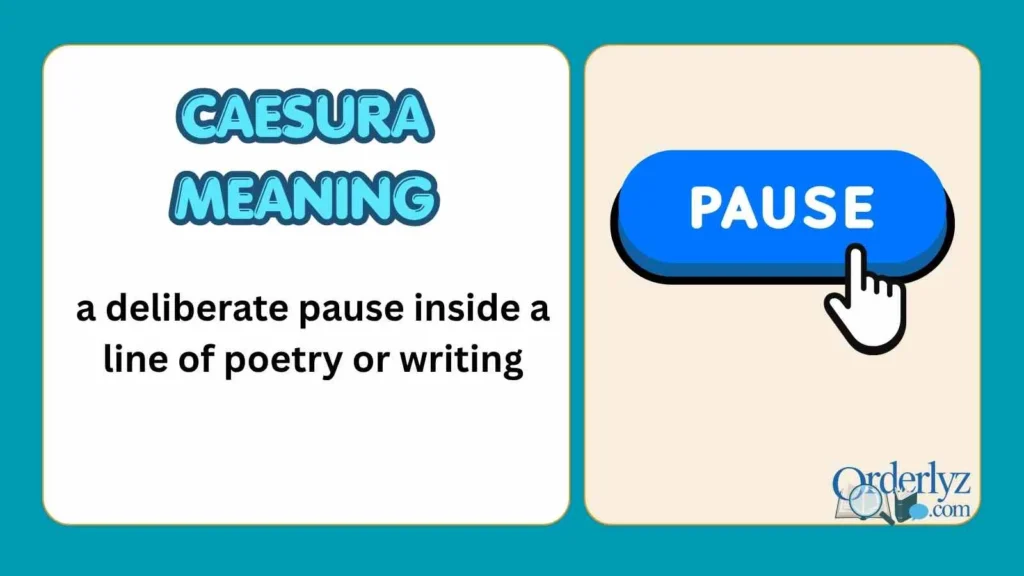
A caesura is a deliberate pause inside a line of poetry or writing, usually marked by punctuation or natural speech rhythm.
The pause may be created by:
- commas
- dashes
- semicolons
- periods
- colons
- natural speaking pauses
Here’s a simple example:
“The woods are lovely, dark and deep.”
The comma creates a brief pause — a soft caesura.
How to Pronounce Caesura
Many people stumble over this word the first time they see it.
It’s pronounced:
suh-ZYOOR-uh
or sometimes
suh-ZUR-uh
The word comes from Latin, which explains the unusual spelling.
Honestly, English literature loves making simple concepts sound intimidating.
The Origin of Caesura
The term “caesura” comes from the Latin word caedere, meaning “to cut”.
That idea fits perfectly because a caesura essentially “cuts” a poetic line into parts.
Ancient Greek and Roman poets used caesuras heavily in epic poetry to do the following:
- control rhythm
- guide oral performance
- help audiences follow long passages
Back then, poetry wasn’t just read silently. It was performed aloud. Pauses mattered a lot more because listeners depended on sound and pacing.
Over time, caesura became one of the most important tools in the following:
- poetry
- drama
- speeches
- song lyrics
- literary prose
Why Caesura Matters in Poetry
Without pauses, poetry can feel flat or robotic.
Caesura gives writing
- breathing room
- emotional texture
- natural rhythm
- dramatic timing
Think of it like music.
A song without pauses would sound overwhelming. Poetry works the same way.
Writers use caesura to:
- slow readers down
- emphasize key ideas
- mimic real speech
- create suspense
- show emotional conflict
Sometimes the silence says more than the words themselves.
Types of Caesura
Not all caesuras sound the same.
Different punctuation creates different emotional effects.
Masculine Caesura
A masculine caesura creates a strong, abrupt pause.
It usually uses:
- periods
- semicolons
- em dashes
Example
“The battle ended — silence remained.”
That dash creates a hard emotional stop.
The effect feels dramatic and forceful.
Feminine Caesura
A feminine caesura feels softer and smoother.
It often uses:
- commas
- lighter pauses
- flowing speech rhythms
Example
“Birds sang softly, drifting through dawn.”
The pause feels gentle rather than sharp.
Medial Caesura
This appears in the middle of a poetic line.
Example
“To be, or not to be — that is the question.”
The pause divides the line naturally.
This is the most common form students encounter.
Famous Caesura Examples in Literature
Some of the most quoted lines in English literature use caesura.
Shakespeare
“Friends, Romans, countrymen, lend me your ears.”
The commas create rhythmic pauses that sound natural during speech.
Shakespeare loved caesura because his plays were meant to be performed aloud.
Alexander Pope
“To err is human; to forgive, divine.”
The semicolon creates balance and emphasis.
Without the pause, the sentence loses much of its elegance.
Emily Dickinson
Dickinson practically built her writing style around pauses.
“Because I could not stop for Death —
He kindly stopped for me —”
Those dashes create hesitation, reflection, and emotional tension.
Her poetry would feel completely different without them.
Modern Song Lyrics
Caesura isn’t trapped in old poetry books.
Artists use it constantly in:
- rap
- spoken word
- pop lyrics
- storytelling music
Listen carefully to dramatic pauses in songs.
That’s often caesura at work.
How to Identify Caesura
Finding a caesura gets easier once you know what to look for.
Signs of Caesura
1. Mid-Line Pause
The pause appears before the line ends.
2. Punctuation
Look for:
- commas
- dashes
- semicolons
- periods
3. Natural Speech Rhythm
Sometimes no punctuation exists, but your voice naturally pauses.
Quick Identification Trick
Read the line aloud.
If your voice naturally stops or slows within the line, there’s probably a caesura.
Poetry is meant to be heard, not just scanned silently.
Caesura vs Enjambment
Students confuse these constantly.
Here’s the easiest way to remember the difference:
| Literary Device | What It Does |
|---|---|
| Caesura | Adds a pause inside a line |
| Enjambment | Continues thought into the next line |
Caesura Example
“The rain stopped suddenly.”
Pause inside the line.
Enjambment Example
“The rain stopped as the sunlight
spread across the hills.”
The sentence flows into the next line.
One interrupts.
The other continues.
Caesura in Modern Writing & Social Media
Interestingly, people use caesura naturally online all the time.
Look at dramatic texting styles:
“I opened the email… and froze.”
That pause creates suspense.
Even TikTok captions use caesura-like pacing:
- “Me walking into the exam, knowing nothing.”
- “He said WHAT?”
Writers, influencers, comedians, and meme creators all use pauses for emotional effect.
They may not call it “caesura”, but the technique is the same.
Emotional Effects of Caesura
Different pauses create different moods.
| Pause Style | Emotional Effect |
|---|---|
| Comma | Gentle reflection |
| Dash | Drama or interruption |
| Period | Finality |
| Semicolon | Balanced contrast |
| Colon | Anticipation |
This is why punctuation matters so much in poetry.
A single dash can completely change the emotional tone.
Common Mistakes & Misunderstandings
Confusing Any Pause With Caesura
Not every pause counts.
A caesura specifically interrupts flow within a line.
Thinking Caesura Only Exists in Poetry
It appears in:
- speeches
- novels
- lyrics
- scripts
- online writing
Even movie dialogue uses rhythmic pauses constantly.
Ignoring Sound
Students often analyse poetry visually but forget audio matters.
Caesura is deeply connected to spoken rhythm.
Always read poems aloud when studying literary devices.
Caesura Across Different Writing Styles
Classical Poetry
Used for rhythm and structure.
Spoken Word Poetry
Creates dramatic tension and emotional pacing.
Rap Music
Helps control beat flow and emphasis.
Fiction Writing
Adds realism to dialogue and narration.
Public Speaking
Makes speeches feel powerful and memorable.
Politicians and performers use strategic pauses constantly.
Related Literary Terms & Alternatives
| Term | Meaning |
|---|---|
| Enjambment | The sentence continues into next line |
| Meter | Rhythmic structure in poetry |
| Iambic Pentameter | Five rhythmic iambs per line |
| Alliteration | Repeated consonant sounds |
| Assonance | Repeated vowel sounds |
| Stanza | Group of poetic lines |
| Line Break | Where a poetic line ends |
| Pause | General stop in speech |
| Rhythm | Flow and beat of language |
| Prosody | Study of poetic rhythm |
Suggested Internal Links
- Learn more about iambic pentameter’s meaning
- Explore enjambment examples
- Read about alliteration’s meaning
- Discover meter in poetry
- Check out assonance vs consonance
FAQs:
What does caesura mean in poetry?
A caesura is a pause within a line of poetry. Writers use it to create rhythm, emphasise ideas, add emotion, or control pacing.
What is a simple example of caesura?
“To err is human; to forgive, divine.”
The semicolon creates a pause inside the line, making it a classic caesura example.
How do you identify a caesura?
Look for punctuation or natural pauses inside a line rather than at the end. Reading poetry aloud often makes caesuras easier to notice.
What is the difference between caesura and enjambment?
Caesura interrupts a line with a pause, while enjambment carries a sentence onto the next line without stopping.
Why do poets use caesura?
Poets use caesura to slow readers down, create emphasis, mimic speech patterns, build suspense, or add emotional depth.
Can a caesura exist without punctuation?
Yes. Sometimes the pause comes naturally from speech rhythm rather than visible punctuation marks.
Final Thoughts:
Understanding caesura meaning changes the way you experience poetry.
You stop reading mechanically and start hearing the rhythm underneath the words. The pauses begin to feel intentional – emotional even.
That’s the magic of caesura.
It turns silence into part of the message.
Whether you’re studying literature, analysing song lyrics, writing poetry, or just trying to survive English class, recognising caesura helps language feel more alive and expressive.
And once you notice it?
You’ll start hearing it everywhere.

Hi, I’m Sophia Brownn, the creator behind Orderlyz.com, where words, meanings, and expressions are made simple, clear, and easy to understand.
I believe language shouldn’t feel confusing or overwhelming. In a world where new slang, trends, and expressions appear every day, my goal is to bring order to the chaos. I break down meanings in a way that feels natural, quick, and actually useful in real life conversations.