Ever opened a shopping app, browsed a product list, or searched for a book in a library system? You’ve already used a catalogue—probably without thinking twice about it.
The catalogue’s meaning goes far beyond just a list. It’s a powerful way to organise information, simplify choices, and guide users—whether you’re shopping online, studying, or managing data. In today’s digital world, catalogues are everywhere, from e-commerce stores to streaming platforms.
Understanding what a catalogue really means (and how it’s used) can make you smarter in navigating systems, communicating clearly, and even creating better content or businesses.
In this guide (updated for 2025), you’ll learn the exact definition, origin, real-world usage, examples, common mistakes, and modern applications of the term “catalogue”.
What Does “Catalogue” Mean?
A catalogue is a structured and organised list of items, information, or resources, usually grouped into categories for easy navigation.
Quick Answer:
A catalogue is a systematically arranged list of items or information designed to help users locate and access things quickly and efficiently.
Origin of the Word
The word “catalogue” comes from the Greek term “katalogos”, meaning “a list” or “register”. It entered English via Latin and French, originally used in academic and library contexts.
Evolution Over Time
- Old usage: Library book listings
- Retail era: Printed product catalogs (think mail-order shopping)
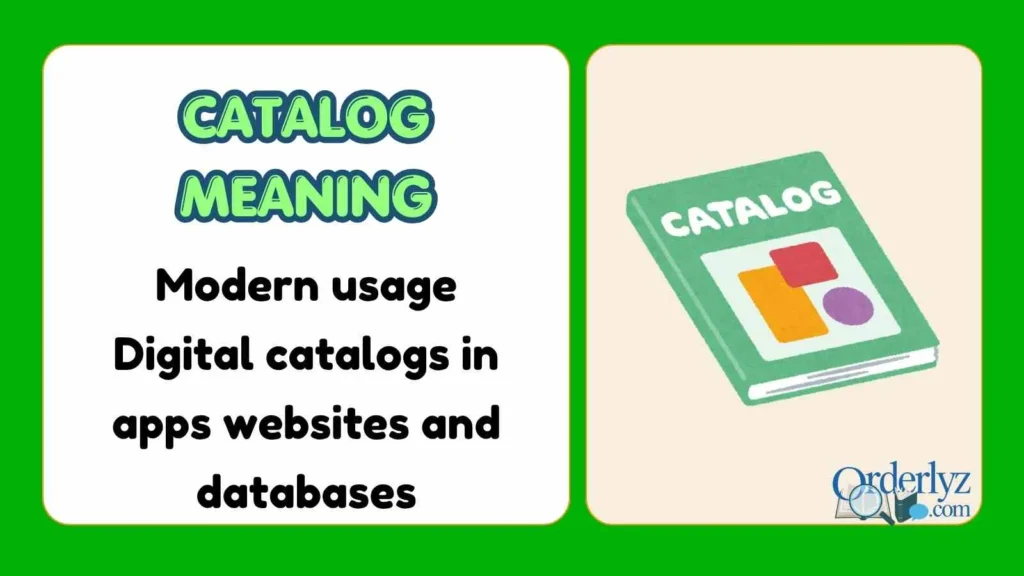
- Modern usage: Digital catalogs in apps, websites, and databases
Today, catalogues are interactive, searchable, and often personalised.
Pronunciation Guide
Catalog: /ˈkæt.əl.ɒɡ/ (UK) or /ˈkæt̬.əl.ɔːɡ/ (US)
How to Use “Catalog” Correctly in Texts & Chat
The term ‘catalogue’ is versatile and works in both formal and casual contexts.
Common Contexts
- Business: product catalogue, service catalogue
- Education: Library catalog
- Technology: data catalogue, app catalogue
Casual vs Formal Use
- Casual: “Check the catalogue for new arrivals.”
- Formal: “The company maintains a comprehensive catalogue of services.”
Platform-Specific Usage
- WhatsApp/SMS: “Send me your product catalogue, please.”
- Instagram: “Link in bio to view full catalog”
- Discord: “The game catalogue just got updated 🔥.”
- LinkedIn: “Explore our service catalog for enterprise solutions”
When NOT to Use It
Avoid using “catalogue”. when:
- Referring to a single item (it’s always a collection)
- In overly informal slang contexts (it’s not slang)
Formatting Tips
- Use lowercase in sentences unless it’s a title
- Pair with descriptors: product catalogue, course catalogue
- Emojis (casual): 🛍️📚 📦
Real Conversation Examples Using “Catalog”
Between Friends
A: Did you see their new catalogue?
B: Yeah, the sneakers are 🔥
👉 Shows excitement about a collection of items
In a Business Chat
Manager: Please update the product catalogue by Friday.
👉 Indicates an organized product listing
In a Family Context
Mom: Please consult the school catalogue for course options.
👉 Refers to an informational listing
In a Dating Scenario
A: Your Netflix catalog is elite. 😄
👉 Playful use to describe a collection of shows
In Gaming
Player: The game catalogue this month is stacked!
👉 Refers to a collection of available games
Common Mistakes & Misunderstandings
1. Confusing “Catalog” with a Single Item
Wrong: “This shirt is a catalogue.”
Right: “This shirt is in the catalogue.”
2. Mixing “Catalog” and “Catalogueue”
- Both are correct
- Choose based on region (US vs UK)
3. Assuming It’s Only Physical
Many people still think catalogues are printed books. In reality, most catalogues today are digital and interactive.
Generational Differences
- Older users: Think mail-order catalogues.
- Gen Z: Think apps, streaming lists, digital collections
Cultural Differences
In global contexts, spelling differences matter more than meaning.
“Catalog” Across Different Platforms & Demographics
Gen Z Usage
- Refers to digital collections (Netflix, Spotify)
- Casual tone, sometimes playful
Millennials
- Use in both professional and digital contexts
- Familiar with print and digital catalogs
Older Generations
- Associate strongly with physical catalogs
Platform Trends
- TikTok: “Amazon catalog finds”
- Instagram: Product catalogs in shops
- E-commerce: Core feature of every store
- SaaS tools: Data/service catalogs
Formality Level
- ✔ Semi-formal
- ✔ Professional-safe
- ❌ Not slang
Related Slang, Abbreviations & Alternatives
| Term | Meaning |
|---|---|
| Inventory | List of available items |
| Directory | Organized listing of names/info |
| Index | Alphabetical list |
| Database | Structured data collection |
| Collection | Group of items |
| Archive | Stored historical records |
| Portfolio | Collection of work |
| Listing | Simple item display |
| Menu | Options list (services/food) |
| Library | Organized resource collection |
FAQ:
What does ‘catalogue’ mean in simple words?
A catalogue is a list of items or information arranged in an organised way so that people can easily find what they need.
Is a catalogue used in digital platforms?
Yes, most catalogues today are digital, including online stores, streaming services, and databases.
Can ‘catalogue’ be used as a verb?
Yes. Example: “We need to catalogue these files,” meaning to organise and list them systematically.
What industries use catalogues?
Retail, education, IT, libraries, e-commerce, and even entertainment platforms all rely on catalogues.
Why are catalogues important?
They make information easy to access, improve organisation, and enhance user experience—especially in large systems.
Conclusion
The catalogue’s meaning may seem simple at first glance, but it plays a giant role in how we organise and interact with information every day.
From shopping online to browsing movies or managing data, catalogues help bring structure to chaos. They’re not just lists—they’re tools that improve efficiency, clarity, and decision-making.
As digital systems continue to grow, understanding how catalogues work gives you an edge—whether you’re a student, business owner, or everyday user.
👉 Got a favourite app or platform with a great catalogue system? Drop it below and share your thoughts!

Hi, I’m Sophia Brownn, the creator behind Orderlyz.com, where words, meanings, and expressions are made simple, clear, and easy to understand.
I believe language shouldn’t feel confusing or overwhelming. In a world where new slang, trends, and expressions appear every day, my goal is to bring order to the chaos. I break down meanings in a way that feels natural, quick, and actually useful in real life conversations.