Imagine standing on a mountain trail after a long hike. You reach the summit, look ahead, and suddenly see miles of rolling hills, forests, and distant rivers stretching toward the horizon. That breathtaking scene is exactly what people mean when they use the word vista.
Understanding vista meaning is useful because the term appears everywhere—from travel blogs and novels to business presentations and everyday conversations. While many people associate it with beautiful landscapes, the word has a deeper meaning that extends beyond physical scenery.
Updated for 2026, this guide explains what vista means, where it comes from, how people use it today, and why writers love the word so much. You’ll also discover real-world examples, common mistakes, related terms, and practical ways to use “vista” naturally in conversation and writing.
Table of Contents
- What Does Vista Mean?
- Origin and History of Vista
- How to Use Vista Correctly
- Real-Life Examples
- Common Mistakes and Misunderstandings
- Vista Across Different Contexts
- Related Words and Alternatives
- Frequently Asked Questions
- Conclusion
What Does “Vista” Mean? (Definition + Origin)
Quick Answer
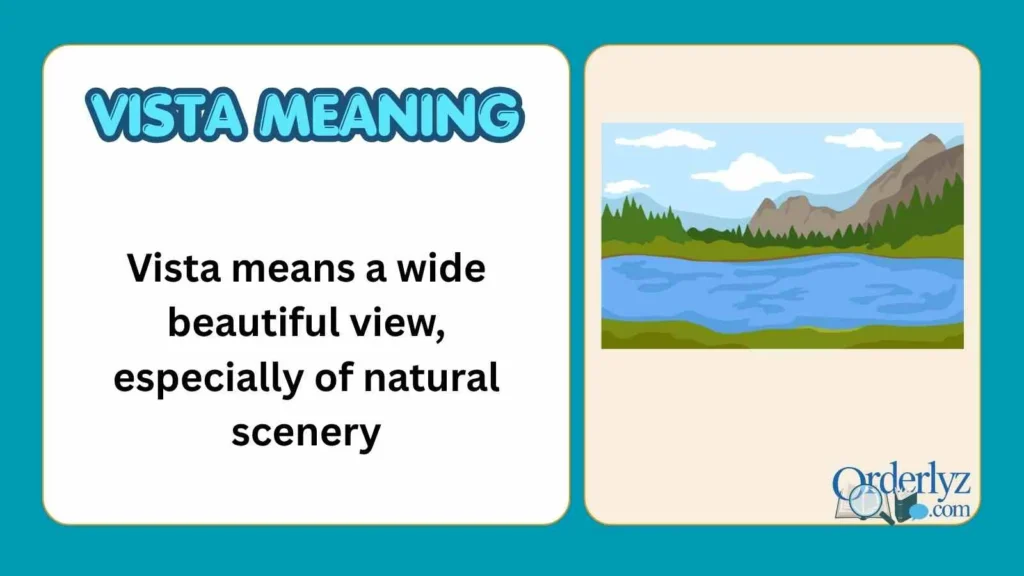
Vista means a wide, beautiful view, especially of natural scenery. It can also describe a new opportunity, perspective, or vision of the future.
Definition
The word vista refers to:
- A broad and pleasing visual scene, often involving landscapes.
- A long, unobstructed view through an avenue, valley, or opening.
- A figurative vision of future possibilities or opportunities.
Pronunciation
Vista is pronounced:
VIS-tuh
/ˈvɪstə/
Origin of the Word
The term comes from the Italian word vista, meaning “sight” or “view.” It traces back to the Latin verb videre, which means “to see.”
English speakers began using the word during the 1600s, particularly in art, architecture, and landscape design. Over time, its meaning expanded beyond physical scenery to include ideas, opportunities, and future prospects.
How the Meaning Evolved
Originally, a vista referred almost exclusively to scenic views. Today, it is commonly used in both literal and figurative ways:
- Scenic vista = beautiful landscape
- New vista = fresh opportunity
- Broader vista = expanded perspective
This dual meaning makes the word especially popular in literature, business writing, and motivational speaking.
How to Use “Vista” Correctly in Conversation and Writing
Unlike many modern slang terms, vista is a formal vocabulary word that works in both casual and professional settings.
Common Uses
Scenic Context
“The mountain trail opened to a stunning vista of the valley below.”
Travel Context
“We stopped at a lookout point to admire the ocean vista.”
Business Context
“The new technology opens exciting vistas for innovation.”
Personal Growth Context
“Studying abroad gave her a whole new vista on life.”
When NOT to Use Vista
Although versatile, vista doesn’t fit every situation.
Avoid using it when:
- Referring to small or ordinary views
- Describing cluttered indoor spaces
- Discussing something negative or restrictive
For example:
❌ “The vista from my kitchen sink is nice.”
✅ “The vista from the mountain overlook was breathtaking.”
The word generally implies grandeur, openness, or inspiration.
Real Conversation Examples Using Vista
Example 1: Travel
Emma: Did you make it to the summit?
Jake: Yes, and the vista was unbelievable. You could see three lakes from the top.
Meaning: Refers to a wide scenic landscape.
Example 2: Photography
Photographer: Wait until sunset.
Friend: Why?
Photographer: The vista becomes incredible when the light hits the mountains.
Meaning: Describes a visually stunning scene.
Example 3: Career Growth
Manager: How was the conference?
Employee: It opened new vistas for our company’s future strategy.
Meaning: Refers to fresh opportunities and possibilities.
Example 4: Education
Student: Studying history changed how I see the world.
Professor: Education often opens new vistas of understanding.
Meaning: Represents expanded perspective.
Example 5: Personal Development
Friend: Why did you move abroad?
Traveler: I wanted to experience new cultures and broaden my vistas.
Meaning: Symbolizes growth and broader horizons.
Common Mistakes & Misunderstandings
1. Confusing Vista With Any View
Many people think vista simply means “view.”
Not exactly.
A vista is usually:
- Wider
- More scenic
- More impressive
- Often panoramic
Every vista is a view, but not every view is a vista.
2. Assuming It’s Only About Nature
While landscapes are the most common usage, vista can also describe:
- Future opportunities
- Personal growth
- New perspectives
- Business potential
This figurative meaning is widely accepted.
3. Using It for Small Spaces
The word suggests openness and scale.
A tiny room or limited sightline generally wouldn’t qualify as a vista.
Vista Across Different Contexts and Demographics
In Travel
Travel writers frequently use vista to describe:
- Mountain overlooks
- Coastal landscapes
- National parks
- Scenic drives
In Literature
Authors use vista to create vivid imagery and evoke emotion.
Example:
“A golden vista stretched before them, fading into the evening mist.”
In Business
Executives and entrepreneurs often use the term metaphorically.
Example:
“The merger creates new vistas for growth.”
In Education
Teachers and academics use it to describe expanded knowledge and understanding.
Example:
“Research opens new vistas in scientific discovery.”
Is Vista Formal or Informal?
Vista is generally considered:
| Context | Appropriate? |
|---|---|
| Academic Writing | Yes |
| Business Writing | Yes |
| Travel Content | Yes |
| Everyday Conversation | Yes |
| Professional Reports | Yes |
| Text Slang | Rarely |
Unlike internet abbreviations, vista is a traditional vocabulary word rather than modern slang.
Related Words, Synonyms & Alternatives
| Word | Meaning |
|---|---|
| Panorama | Wide, sweeping view |
| View | General sight from a location |
| Outlook | Perspective or future expectation |
| Prospect | Future possibility |
| Horizon | Distant visible limit |
| Landscape | Visible natural scenery |
| Scenery | Attractive natural surroundings |
| Perspective | Point of view |
| Outlook | Way of seeing things |
| Vision | Future goal or possibility |
Synonyms
- Panorama
- Landscape
- Prospect
- Outlook
- View
- Scene
Near Opposites
- Obstruction
- Barrier
- Limitation
- Restriction
- Blind spot
Suggested Related Articles
- Panorama Meaning
- Horizon Meaning
- Perspective Meaning
- Outlook Meaning
- Vision Meaning
Why Writers Love the Word Vista
There’s a reason travel journalists, novelists, and speakers often choose vista instead of simply saying view.
The word creates emotion.
It suggests:
- Wonder
- Exploration
- Freedom
- Opportunity
- Discovery
A “view” tells readers what someone sees.
A “vista” helps them imagine standing there themselves.
That’s a powerful difference.
FAQs:
What does vista mean in simple words?
Vista means a wide and attractive view, usually of natural scenery. It can also refer to a new opportunity or broader perspective.
Is vista only used for landscapes?
No. While it’s commonly used for scenic views, vista can also describe future possibilities, personal growth, or new opportunities.
What is a scenic vista?
A scenic vista is a broad, beautiful landscape view, often seen from elevated locations such as mountains, hills, or observation points.
Can vista be used metaphorically?
Yes. People often use vista metaphorically when discussing opportunities, innovation, education, or personal development.
What is the difference between vista and panorama?
Both describe wide views. However, panorama emphasizes a complete sweeping scene, while vista often highlights depth, perspective, and visual beauty.
Is vista a positive word?
Almost always. The term typically conveys beauty, opportunity, optimism, and openness.
Where is the word vista commonly used?
You’ll often see it in travel writing, literature, business communication, education, architecture, and landscape design.
Conclusion:
The vista meaning goes far beyond a simple view. At its core, a vista is a broad, impressive scene that inspires a sense of wonder and possibility.
Whether you’re describing a breathtaking mountain overlook, a promising business opportunity, or a new perspective on life, the word carries a sense of openness and discovery that few alternatives can match.
The next time you hear someone mention a vista, you’ll know they’re talking about more than what can be seen—they’re often talking about what can be imagined as well.
What’s your favorite scenic vista you’ve ever experienced? Share it in the comments and explore more fascinating word meanings and language guides.

Hi, I’m Sophia Brownn, the creator behind Orderlyz.com, where words, meanings, and expressions are made simple, clear, and easy to understand.
I believe language shouldn’t feel confusing or overwhelming. In a world where new slang, trends, and expressions appear every day, my goal is to bring order to the chaos. I break down meanings in a way that feels natural, quick, and actually useful in real life conversations.