Ever agreed to something and later thought, “Wait… I can’t undo this?” That’s where the word ‘irrevocable’, meaning, becomes important.
In today’s world—where contracts, digital agreements, and even relationships move fast—understanding terms like irrevocable isn’t just for lawyers anymore. Whether you’re signing documents, reading policies, or just trying to level up your vocabulary, this word shows up more often than you’d expect.
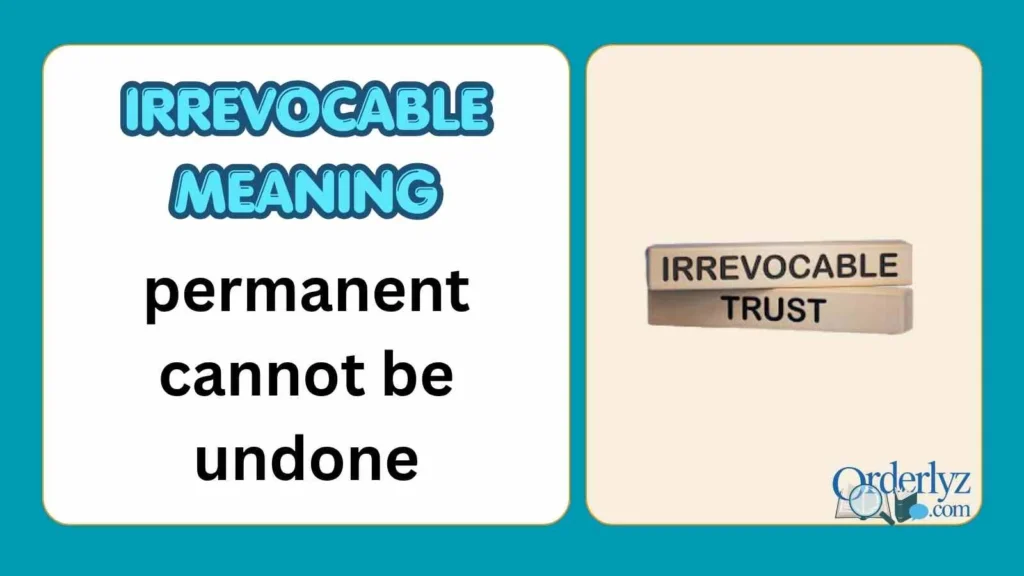
The irrevocable meaning is all about permanence. Once something is set, there’s no going back. Sounds serious, right? That’s because it often is.
In this updated 2025 guide, you’ll learn exactly what ‘irrevocable’ means, how to use it correctly, real-life examples, common mistakes, and how it compares to similar terms. Let’s break it down in plain English.
What Does “Irrevocable” Mean? (Definition + Origin)
Irrevocable means something that cannot be changed, reversed, or undone once it has been decided.
Quick Answer:
Irrevocable = permanent + cannot be undone
Origin & Etymology
The word comes from Latin:
- “ir-” = not
- “revocare” = to call back
So literally, it means “not able to be called back”.
Evolution of Meaning
Originally used in legal and formal writing, the term has expanded into everyday language. Now you might hear it in conversations about decisions, relationships, or even life choices.
Pronunciation
ih-REV-uh-kuh-buhl
How to Use “Irrevocable” Correctly in Texts & Chat
Let’s be honest—this isn’t typical slang you’d drop in a meme chat. But it can be used in modern communication when you want to sound clear or serious.
Tone & Context
- Formal: legal, contracts, business emails
- Semi-formal: serious discussions, important decisions
- Rare in casual texting unless used humorously
Platform Usage
- WhatsApp / SMS:
“Bro, that decision is basically irrevocable now. 😅” - Instagram / X:
“Some choices are truly irrevocable.” - Discord / Reddit:
Used in debates or serious discussions
When to Use It
✔ When something is final
✔ When emphasizing seriousness
✔ When discussing legal or financial topics
When NOT to Use It
✖ Casual jokes (unless ironic)
✖ Light conversations
✖ Situations where change is still possible
Formatting Tips
- Usually lowercase unless starting a sentence
- No abbreviation
- Can pair with serious emojis: ⚖️ 📜 😬
Real Conversation Examples Using “Irrevocable”
1. Between Friends
A: “Did you submit your university application?”
B: “Yeah… it’s irrevocable now.”
👉 Emotion: Finality with slight anxiety
2. In a Relationship
A: “Are you sure about this decision?”
B: “Yes. It’s irrevocable.”
👉 Emotion: Serious commitment
3. Work Chat
Manager: “Once approved, the contract becomes irrevocable.”
👉 Emotion: Professional and formal clarity
4. Family Discussion
Parent: “Selling the house is an irrevocable decision.”
👉 Emotion: Weight and responsibility
5. Gaming Context
Player: “Bro I deleted my main account. Irrevocable move 😭”
👉 Emotion: Regret + humor
Common Mistakes & Misunderstandings
1. Confusing It With “Hard to Change”
Irrevocable doesn’t mean difficult—it means impossible to undo.
2. Using It Too Casually
Saying “My hairstyle is irrevocable” sounds dramatic (unless joking).
3. Generational Confusion
- Younger users may exaggerate usage
- Older users may restrict it strictly to legal contexts
4. Cultural Differences
In some regions, it’s mostly used in legal language, not daily speech.
How to Clarify
If someone looks confused, just say the following:
“It means it can’t be undone.”
“Irrevocable” Across Different Platforms & Demographics
Gen Z
- Rare in slang
- Used ironically or dramatically
Millennials
- More likely to use it correctly
- Seen in professional communication
Older Generations
- Strong association with legal/financial terms
Platform Trends
- TikTok: Rare, unless educational
- Instagram: Inspirational captions
- Discord/Reddit: Serious debates
Formality Level
- Highly formal
- Safe for work ✔
Related Slang, Abbreviations & Alternatives
| Term | Meaning |
|---|---|
| Permanent | Lasts forever |
| Final | No changes allowed |
| Binding | Legally enforced |
| Set in stone | Cannot be changed |
| Done deal | Already decided |
| Locked in | Confirmed and fixed |
| No turning back | Irreversible situation |
| Revocable | Can be changed (opposite) |
| Fixed | Not flexible |
| Absolute | Complete and final |
FAQs;
What does irrevocable mean in simple terms?
It means something cannot be undone or changed once it’s finalised. Think of it as a permanent decision.
Is ‘irrevocable’ always legal?
No, but it is commonly used in legal and financial contexts. It can also describe everyday decisions.
What is an irrevocable decision?
A choice that cannot be reversed after being made, regardless of consequences.
What is the opposite of irrevocable?
Revocable, meaning something can be changed or cancelled.
Can the irrevocable ever be reversed?
In most cases, no. However, rare legal exceptions may apply depending on the situation.
Conclusion:
The irrevocable meaning is simple but powerful—it represents decisions or actions that are final and unchangeable.
Understanding this word helps you navigate contracts, serious conversations, and even life decisions with more clarity. It’s not just vocabulary—it’s awareness.
Use it wisely. Because once something is truly irrevocable… There’s no undo button.
Want to keep levelling up your language skills? Explore more terms, and drop your favourite word or phrase below.

Hi, I’m Sophia Brownn, the creator behind Orderlyz.com, where words, meanings, and expressions are made simple, clear, and easy to understand.
I believe language shouldn’t feel confusing or overwhelming. In a world where new slang, trends, and expressions appear every day, my goal is to bring order to the chaos. I break down meanings in a way that feels natural, quick, and actually useful in real life conversations.