Ever seen someone mention CODA online or in a conversation and wondered what it actually means? You’re not alone. The term pops up in social media, movies, and discussions about identity—but many people misunderstand it.
The coda meaning deaf isn’t just a definition. It’s tied to real families, cultures, and lived experiences. If you’ve heard it in passing or saw it trending recently, understanding it can give you a whole new perspective on communication and identity.
In this guide (Updated for 2025), you’ll learn exactly what CODA means, where it comes from, how it’s used in everyday conversations, and why it matters more today than ever.
What Does “coda meaning deaf” mean? (Definition + Origin)
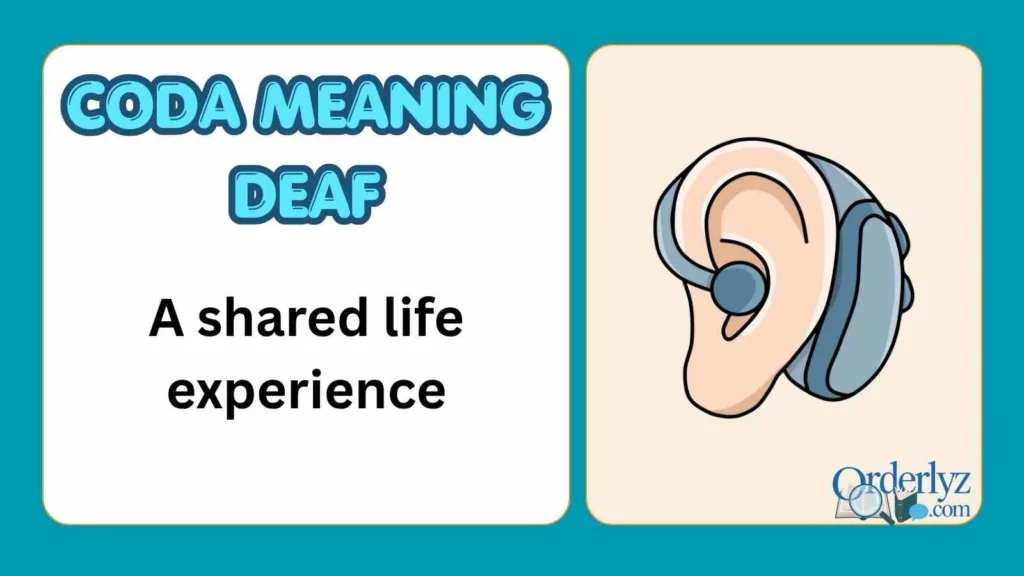
CODA stands for Child of Deaf Adults.
It describes a hearing person who was raised by one or more deaf parents.
Quick Answer:
A CODA is a hearing individual born to deaf parents, often fluent in sign language and deeply connected to deaf culture.
Origin of the Term
The term “CODA” gained recognition in the 1980s through the organisation CODA International, which supports people with deaf parents. It became widely known again after the 2021 film CODA brought mainstream attention to the concept.
How the Meaning Has Evolved
Originally, it was just a descriptive label. Today, it represents the following:
- A cultural identity
- A linguistic bridge between deaf and hearing worlds
- A shared life experience
Pronunciation
CODA is pronounced KOH-duh.
How to Use “Coda” Meaning “Deaf” Correctly in Texts & Chat
The term ‘CODA’ isn’t slang in the usual sense—it’s more of an identity label. So using it correctly matters.
When to Use It
Use CODA when:
- Talking about someone’s background or identity
- Discussing deaf culture
- Referring to experiences growing up with deaf parents
Example Contexts
- Casual: “She’s a CODA, so she knows sign language fluently.”
- Educational: “The coda meaning ‘deaf’ refers to hearing children of deaf adults.”
Platform-Specific Usage
- WhatsApp/SMS: Simple explanation in conversation
- Instagram/TikTok: Often used in captions or storytelling
- Reddit/Discord: Used in discussions about identity or experiences
When NOT to Use It
Avoid using CODA:
- As a joke or meme
- Without understanding its meaning
- In professional contexts without clarity
Formatting Tips
- Always capitalize: CODA
- No emojis needed unless in a casual context
- Use respectfully—it represents real people
Real Conversation Examples Using “coda” meaning “deaf”
1. Between Friends
A: “How do you know sign language so well?”
B: “I’m a CODA. My parents are deaf.”
👉 Shows identity and background.
2. In a Group Chat
User1: “What does CODA mean?”
User2: “It means Child of Deaf Adults.”
👉 Informational and educational use.
3. Dating Scenario
Person A: “Fun fact—I’m a CODA.”
Person B: “That’s awesome. Do you use sign language daily?”
👉 Builds curiosity and connection.
4. Family Conversation
Child: “Why does she sign so fast?”
Parent: “She’s a CODA; she grew up with it.”
👉 Explains fluency naturally.
5. Workplace Chat
Colleague: “She’s a CODA, so she’s helping translate.”
👉 Practical use in real situations.
Common Mistakes & Misunderstandings
1. Thinking ‘CODA’ Means ‘Deaf Person’
Wrong. A CODA is usually hearing, not deaf.
2. Using It as Slang
CODA isn’t internet slang like “LOL”. It’s an identity term.
3. Assuming All CODAs Are the Same
Not all CODAs:
- Use sign language fluently
- Identify strongly with deaf culture
Generational Confusion
- Older generations: May not recognize the term
- Gen Z: More aware due to media and social platforms
Cultural Differences
In some regions, the term is widely known. In others, people may need explanation.
“coda meaning deaf” Across Different Platforms & Demographics
Gen Z vs Millennials
- Gen Z: Uses CODA more openly in identity discussions
- Millennials: Familiar but less likely to use casually
Social Media Trends
- TikTok: Personal stories from CODAs
- Instagram: Awareness posts
- Reddit: Deep discussions
Formal vs Informal?
- Semi-formal
- Safe for work (when explained properly)
Viral Influence
The film CODA made the term globally recognised, increasing searches for ‘coda meaning deaf’ dramatically.
Related Slang, Abbreviations & Alternatives
| Term | Meaning |
|---|---|
| SODA | Sibling of Deaf Adults |
| KODA | Kids of Deaf Adults |
| ASL | American Sign Language |
| Deaf Culture | Shared identity of deaf community |
| Hard of Hearing | Partial hearing loss |
| Interpreter | Person translating sign/spoken language |
| Bilingual (Deaf Context) | Uses sign + spoken language |
| Hearing | Person who can hear |
| Deaf | Person with hearing loss |
| Signer | Someone who uses sign language |
FAQs:
What does CODA mean in simple terms?
CODA means “Child of Deaf Adults”. It refers to a hearing person raised by deaf parents, often familiar with both spoken and sign language.
Is CODA a disability?
No. Being a CODA is not a disability. It describes a family background and cultural experience.
Can a CODA be deaf?
Usually no, but in rare cases, a child of deaf adults can also be deaf.
Why is CODA important?
It highlights the unique role of people who connect deaf and hearing communities, often acting as translators or cultural bridges.
Do all CODAs use sign language?
Most do, but not all. It depends on upbringing and environment.
Conclusion:
Understanding ‘coda’ meaning ‘deaf’ goes beyond memorising a definition. It opens a window into a unique life experience shaped by language, culture, and connection.
CODAs often grow up balancing two worlds—hearing and deaf—making them natural communicators and cultural bridges. That’s what makes the term so meaningful.
Now that you know what CODA really means, you’ll spot it everywhere—from conversations to social media to real-life stories.
Got a favourite term or abbreviation you want explained next? Drop it and keep exploring the world of modern communication.

Hi, I’m Sophia Brownn, the creator behind Orderlyz.com, where words, meanings, and expressions are made simple, clear, and easy to understand.
I believe language shouldn’t feel confusing or overwhelming. In a world where new slang, trends, and expressions appear every day, my goal is to bring order to the chaos. I break down meanings in a way that feels natural, quick, and actually useful in real life conversations.